How it all Started

By Rob Lamb – EcoForesters Founder

After 10 years of creativity, vision, and dedication, it is time to reflect and celebrate EcoForesters’ 10th birthday! Thanks to the hard work of our staff and board–and the incredible support we’ve received from donors, landowners, and conservation partners–EcoForesters has become an innovative leader in forest conservation and restoration. I hope this article provides a deeper understanding of why EF is an essential organization that needs your ongoing support to achieve our mission. In 2026, we will roll out our vision for the next 10 years of EF’s work. If you’re impressed with what we’ve done so far…you ain’t seen nothing yet!

Appalachian Forests: Amazing and Integral

Appalachian forests are, without a doubt, among the world’s greatest natural resources. Among the oldest mountain chains in the world, our forests are a spectacular life force of green, harboring abundant wildlife and intense biodiversity, deep nutrient-rich soils, a massive source of clean and cool air, and abundant crystal clear water. Appalachian forests and harvested wood products store the equivalent of 19 years of all CO2 emissions produced across the states. Nearly 10,000 species are known to inhabit the Southern Appalachian region alone, and it hosts the highest aquatic biodiversity in North America.  

Appalachian forests are the playground for millions, leading to billions of dollars in tourism and outdoor recreation, while the Appalachian forest products industry is another multi-billion-dollar business. Millions of jobs depend on a vibrant and sustainable Appalachian forest. In addition to being a main source of our income, they literally provide us with the air, water, food, and shelter we need to survive. 

Putting the importance of our forests into view provides perspective on the value of EcoForesters’ mission. Sustaining our forests is foundational and essential for our very survival. The work EcoForesters does each and every day, thanks to your support, helps sustain us and future generations. 

Why I Started EcoForesters

From a young age, I was able to develop a personal relationship and appreciation for these forests. What started with family backpacking trips in the North Georgia mountains ultimately led to a 2,000-mile thru-hike of the Appalachian Trail in 2001, a master’s degree in forestry in 2005, and the start of a forestry career in Western North Carolina in 2006. Until 2014, I worked as a forestry consultant for hundreds of landowners, visiting tens of thousands of acres. There, I learned firsthand the untold story of Appalachian forest degradation beneath the green forest canopy.

It is easy to take Appalachian forests for granted. They’ve always been there, and any changes typically happen slowly and can be virtually imperceptible to us in our busy lives. But to understand trees and forests, we have to think in terms of decades and even centuries. Taking this into perspective, our forests have been resilient against massive assaults at our hands. Appalachian forests today bear the scars of mass clear-cutting at the turn of the 20th century, a legacy of high-grading and industrial forestry over the past 70 years, the introduction and spread of exotic invasive plants and diseases that have wiped out integral tree species and halted forest regeneration, and urban sprawl that fragments forests into more edge habitat of diminished health. An early EcoForesters employee coined a common saying amongst our staff these days: “Just because it’s green, doesn’t mean it’s healthy.” While each individual patch of forestland may still be full of life, when looking at Appalachian forests at a large scale of space and time, we see that our forest is losing its capacity to regenerate itself and is providing diminished benefits in wildlife habitat, biodiversity, clean air, and clean water. 

I became keenly aware of this reality while working as a forestry consultant for nearly 10 years. Time and time again, I saw degraded forests at risk of regenerative failure from past abuse and invasive plants and insects. I came to understand that both the prevailing conservation mindset of preservation, as well as the for-profit forestry model, were failing forests and landowners alike, inadequately structured to meet their needs. Small private landowners own approximately 70% of Appalachian forests, yet without appropriate public and professional support, their forestland (and the forests everyone depends on for clean air and clean water) will continue to degrade.

The days of standing by and letting “nature take its course” would not provide the outcomes we need to survive. Likewise, looking at our forests for short-term profit from forest products would continue to degrade them. Rather, we needed to invest in the restoration of forestland. We must engage as active stewards of our forests and restore forestland, acre by acre, working landowner by landowner, so that forests can regain their capacity to maximize ecological benefits for all.

The solution: a non-profit professional forestry organization with a forest conservation and restoration mission, a mission aligned with the goals of so many landowners who desire to sustainably steward their land. While there were some conservation non-profits that advocated for good forestry, few were staffed with expertise in forest management, and none were actually capable of doing the work. With no proven model for success, starting this organization would be pioneering a new, yet essential path for the future of our forests; so nearly 10 years ago, I founded EcoForesters.

EcoForesters: Years 1-10

Ten years later, I think it’s safe to say that EcoForesters has been a tremendous success. Our success has not been linear, and while we’ve had our ups and downs, our overall growth and impact have been exponential. Our staff and subsequent impact have doubled roughly every 2 years. The results: long-term stewardship care on over 250,000 acres and with over 600 landowners, over 10,000 landowners engaged via outreach or direct consultation, invasive species controlled, and forest restoration on over 3,000 acres (including over 500 acres on permanently protected conservation lands), and a staff that has grown from 2 in 2015 to 26 in 2025.

Having multiple funding sources helps increase our stability and impact. EcoForesters channels private donations towards landscape restoration planning, stewardship on permanently protected land, and our outreach and education programs, while our direct forest stewardship work is funded by a combination of grants and investment from forest landowners themselves.  When you look closely at the relative investment of funds, our impact is even more impressive. For example, $250 would help us reach over 500 landowners, conduct stewardship planning on 10 acres, or invasive plant control on 1 acre. While permanently protecting land is an important part of overall conservation, the vast majority of forestland remains in the hands of private landowners. If conservation funding isn’t adequately channeled to this land base, then the risk to the future of our forests will substantially increase.

Much of forest conservation funding today is funneled towards reducing climate change and increasing ecosystem services. Here too, EcoForesters has an outsized impact. Through internal studies and forest growth modeling, we’ve found that over 10-30 years, forests where we’ve controlled invasive plants sequester 1 additional metric ton of carbon dioxide per acre per year than if the same forest had gone untreated. So far, the work of our forest restoration crew has led to an additional 3,000 tons per year of carbon sequestration, a number that will greatly increase in the years to come as we continue our work. Our sustainable forest management practices that mimic natural processes, promote species diversity, and retain healthier trees also lead to significantly more carbon storage. While there is currently no carbon offset market that sufficiently incentivizes landowners for this kind of work, EF is working with landowners to do the work anyway, leading to real additional carbon sequestration to mitigate climate change. 

After 10 years, EcoForesters has proven it is a model organization that can sustainably grow and replicate to positively impact forests at a landscape scale, demonstrating the essential path we must take to sustain forests and the benefits that forests provide. Over the years, our effectiveness has been increasingly recognized by countless landowners, public and private conservation partners, and significant funding opportunities. As a result, EcoForesters in 2025 is a rapidly growing organization that is highly effective in leveraging available resources to achieve the greatest impact towards its mission. 

Join EcoForesters for the next 10 years and beyond

The next 10 years are of outsized importance in determining the future of our planet. No individual conservationist, organization, or government is going to make the difference in stemming the impact of climate change and conserving forests, biodiversity, clean water, and wildlife for future generations. It will undoubtedly be a group effort. What I can say with the utmost confidence is that EcoForesters is a key cog towards achieving local and global conservation goals. As we celebrate our 10th birthday, our work is just beginning, and we are positioned to replicate our model and extend conservation and stewardship to make what we’ve achieved so far seem like a drop in the bucket. 

Our staff works tirelessly because they understand the importance of our work. If you are reading this article, you also understand and are committed to EF’s work. And for those that don’t yet know about EF, they are also a part of our greater forest ecosystem. The question is: how will we proceed? Can we sustain our forests and the benefits they provide? The answer: we can and will sustain our forests, and we will do it using EcoForesters as a model. We have a plan for the next 10 years, and it depends on your support! What part will YOU play in sustaining our forests?
Ten Years: Just a Sapling in Forestry Years!

After a decade, EcoForesters is just getting started. But if you’re a white oak, your height and your likelihood of making the overstory have most likely already been decided for you. In forests, trees are in constant competition for light. When a disturbance opens the canopy, phototropic species quickly move in to claim the new territory. Once that space is filled, little sunlight reaches the forest floor–and until the next disturbance, the order is set. The trees that reach the tallest heights should have all the sun they need until they meet their demise. Those that didn’t “win” will be stunted in growth and make the most of their midstory conditions.

Post-Helene, we are witnessing a blowdown of historic proportions, including a surprising amount of oak trees. What comes back in this space depends on what species were present and what are still alive. Oaks are known for their strong roots and spend their early years growing down. This means that other species that start by growing upward have an advantage. Nature can be harsh, with brutal competition for growing space…truly survival of the fittest–or in this case, the fastest growing. Unfortunately, what grows fast is mostly non-native species or trees like maple and poplar. We don’t play favorites with healthy trees, but we do acknowledge the valuable role oaks play in the greater forested ecosystem.

What comes back on those 800,000 acres impacted by Helene will impact our region’s water, wildlife, climate, and ability to withstand future wildfires and drought. This is why EcoForesters is helping landowners by writing regeneration plans in areas disturbed by Helene. Man-made disturbances like a timber harvest can be carefully planned and executed, including accounting for future generations. Natural disasters, on the other hand, are unplanned and require planning on the backend that will call for active stewardship over the next ten years. There is much work to be done, but we have an opportunity to shape our forests as we help them recover.

Ten Years Down, One Year In: Helene Will Define Our Next Ten Years

This year has been filled with a wide range of emotions for EcoForesters staff. While we’re proud of our ten years in existence and the difference we’re making in the field of forestry, we are heartbroken on a weekly basis as our staff witnesses the damage still visible from Helene. We are reminded daily that our mission to restore and conserve forests is site-specific, and in some cases, it means asking people to be patient. If you have dealt with the destruction of your forest, the loss of or damage to your home, and countless unplanned expenses, being told to be patient can be hard to hear.

I am in my sixth year at EcoForesters. As a non-forester, I continue to learn from my colleagues that change happens incrementally and often undetected. The fruits of today’s decisions are often not realized until decades later. And the ability to capitalize on those decisions–for instance, through a timber harvest–can be wrecked in the blink of an eye (or storm). Many landowners who had the security of a future timber harvest that could help pay for college tuition, retirement, or an unexpected health expense are now realizing that opportunity is gone. This loss was paired with damage to their forest that must be accounted for, often at an expense. It was quite the turn of events for thousands of people.

We are also reminded daily that we don’t have all of the answers. Many problems will require funding to offset the costs of debris removal or wildfire mitigation. Figuring out how to restore and regenerate 800,000 acres of storm-damaged forest is a first for this region, but the solutions we’re discovering are already being put into action. Through the help of agencies, NGO partners, and tenacious landowners, we are providing helpful advice and action that reduces risk and takes another step toward future forest health.

With the reduction in agricultural and forestry agency budgets and staff, we will see a reduction in capacity from the people best suited to help. The unforeseen costs for landowners due to Helene are still being realized, meaning that important restoration and regeneration work will be neglected to pay for more immediate needs. A year after this storm of the century, one thing is clear: assistance in the form of professional expertise will be essential, and we will need creativity to help fund the work that must be done.

Despite the difficulties of the last year, we still have much to celebrate after a decade of EcoForesters. Our mission is needed, and our methods are working. We hope you will continue to stay interested and supportive of our work for the next ten years. Thank you for sticking with us!

Logs Logs Everywhere

The devastation that Hurricane Helene caused will be felt for untold years, among that being a large influx of downed trees of all sizes and species. Landowners have no doubt noticed the increase in coarse woody material deposited on the forest floor. While some may consider it unsightly, it’s important to look at the fallen trees through an ecological lens and recognize the positives this glut of material can offer the forest habitat.

We talked with Joey Borders, Forester with EcoForesters, for his take on what the storm aftermath means for organisms large and small. He explained that a natural forest is a shifting matrix of successional stages, with historical storm disturbances shaping the forest. 

“What we have now in the modern era is second or third growth forests that have been shaped by logging. Trees are all cut at once, resulting in a continuous canopy that has been in place for decades, and an altered understory that lacks structural diversity,” he said. 

When Helene knocked down so many trees, it tipped the scales in favor of a more natural forest that provides habitat for all organisms in the food chain. The coarse woody material (not debris) provides mulch that regulates moisture on the forest floor, fertilizer for emerging plants, and habitat for everything from insects, rabbits, rodents, snakes, ground nesting birds and woodpeckers looking for meals in snags. This woody material was greatly lacking before the storm, and now the needle has been greatly turned the other way, providing an opportunity for the food chain to thrive.

“In terms of establishing historical conditions, this kind of disturbance is representative of these stand replacing disturbances that we often talk about that have historically shaped our forest. In that regard, that would be a positive,” said Borders. “There are opportunities that come out of an event like this.”

Species that thrive in early successional habitats like ruffed grouse, golden-winged warbler and even deer and foraging ungulates will have increased habitat to explore, said Borders. 

  “As the forest grows in, there will be shrubs and herbaceous species that thrive with the increased spatial and light resources, all species that either forage or nest in those circumstances will have an advantage,” said Borders.

Since our forests have been greatly shaped by human influence, there are risks to just walking away and allowing them to naturally regenerate. Non-native invasive species have a chance to explode in the sunlight. Borders also said that since the forests have had a consistent canopy for so long, mesic species  (ones that thrive in more moisture) have an advantage over others. 

In terms of dealing with fallen trees in a landowner’s forest in the most ecological way possible, non-traditional forest products such as cultured mushrooms on logs are a great ingredient in the mix. Borders said that a diversity of thinking will be required, with a mix of using the logs and mitigating fuels that should be a concern. 

“Salvage logging is an option that I think is appealing to a lot of people because it allows you to offset some of the cost of managing those fuels, but there’s an increasingly limited window we have to salvage logs. There’s only going to be a few more months where it’s reasonable to get merchantable timber,” he said.

Clearing Local Trails

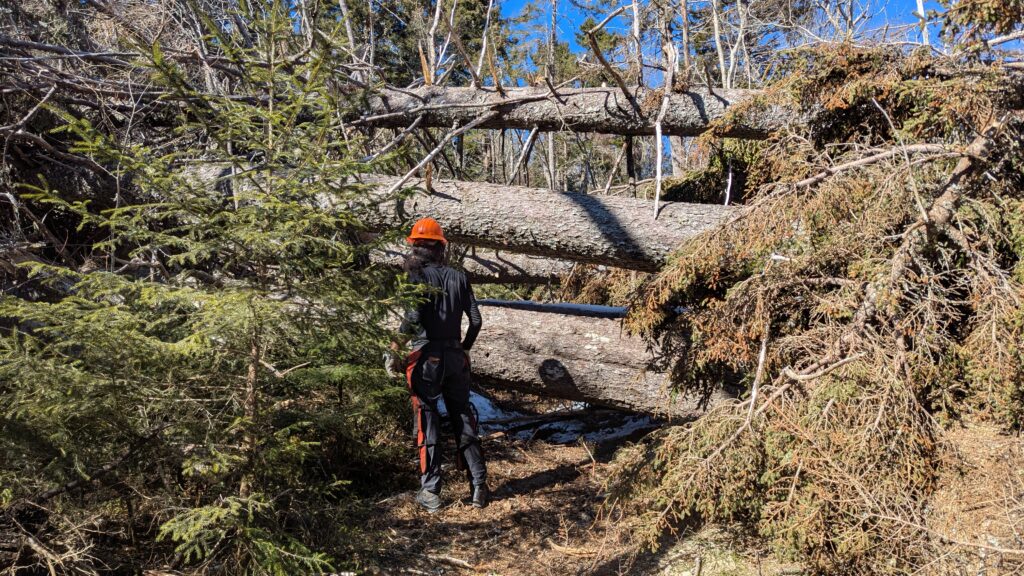
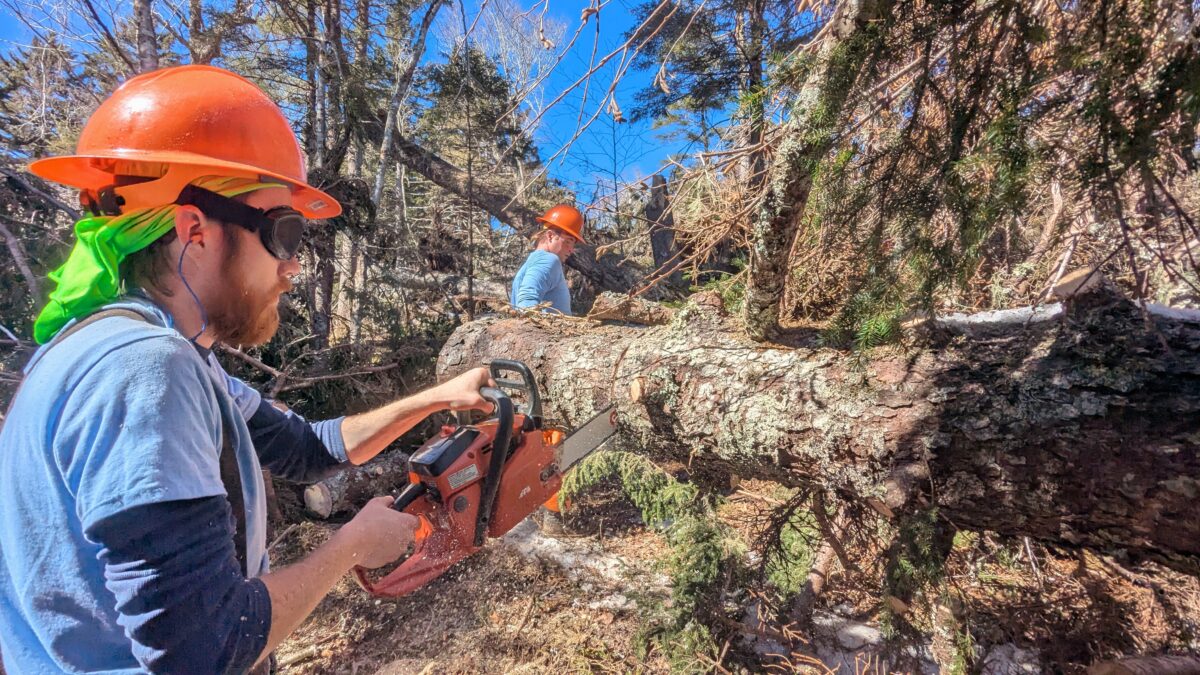
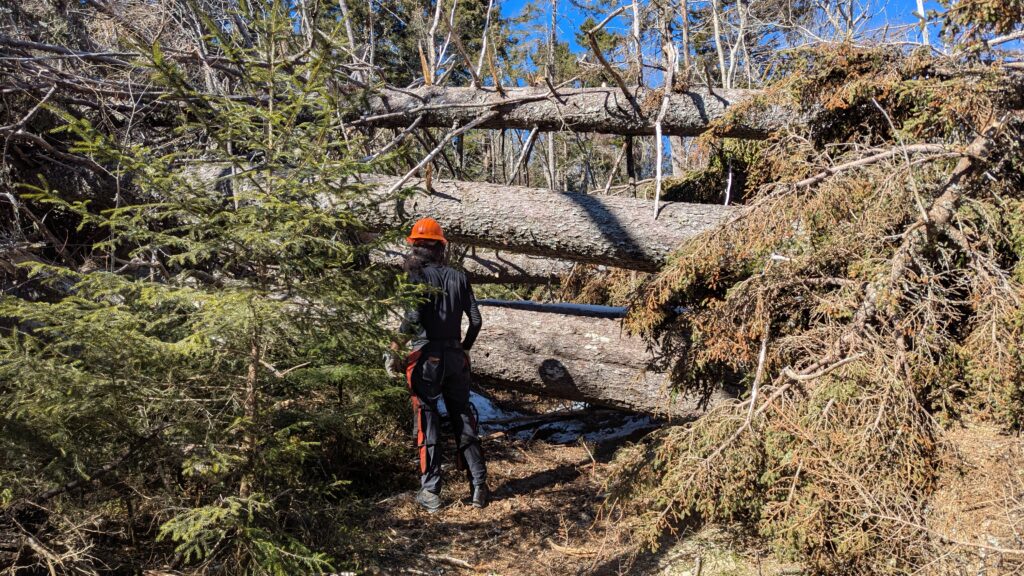
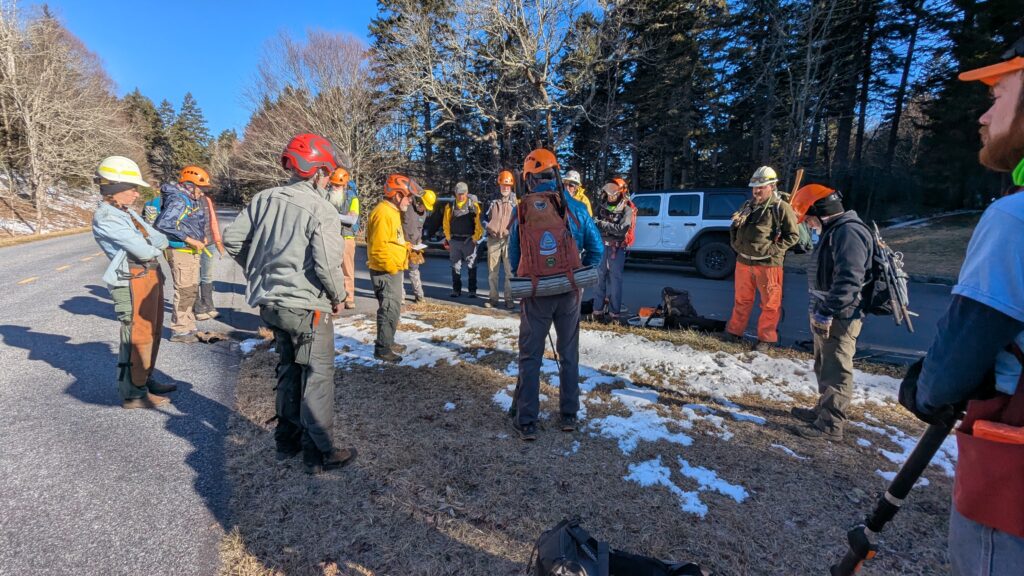
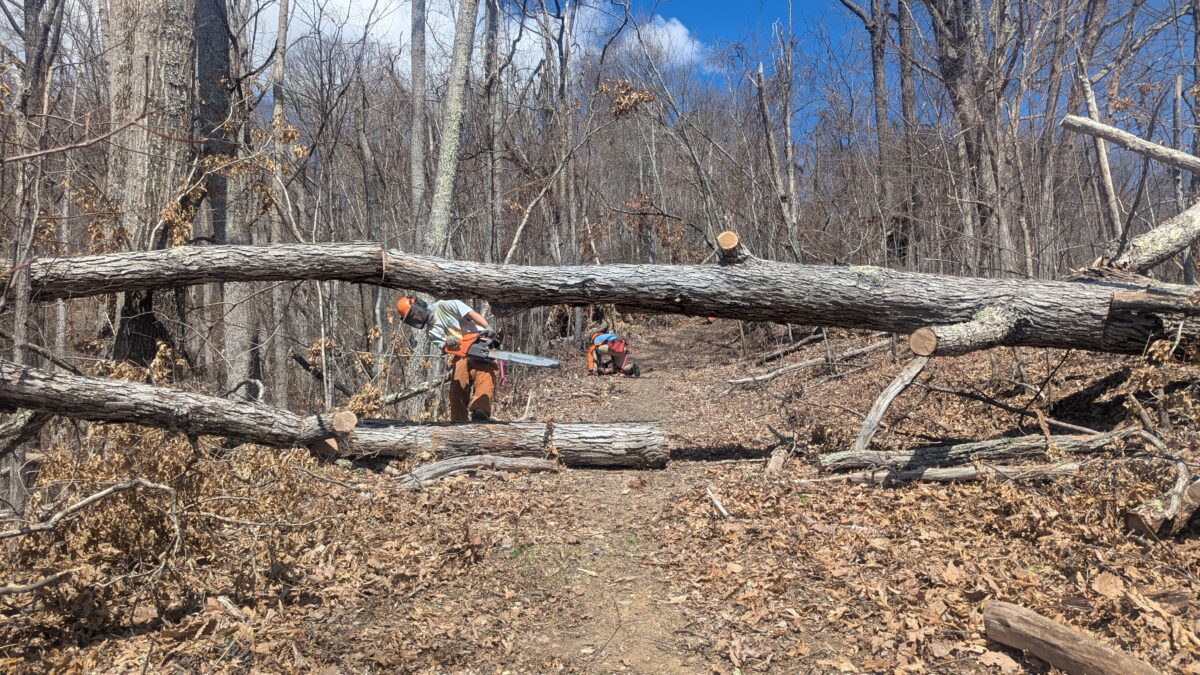
The snow hissed as it touched the hot exhaust on my chainsaw. It was February 24, and I was crawling under a fallen pine on the way back to the EcoForesters truck, parked at the Big Butt trailhead on the Blue Ridge Parkway. Our crew had just worked with the U.S. Forest Service and volunteers of the North Carolina High Peaks Trail Association to clear as much of the trail as we could in a day. We encountered walls of large trees. It was a mess. 

After Helene hit, the usual once in a while log blocking a trail had become many fallen trees, some stacked on top of each other, blocking numerous parts of trails. Big root balls towered into the air, with the corresponding hole sometimes exploding a trail like World War 1 artillery fire. Trees were twisted from tremendous wind force, the tops broken off and tossed down the mountain. 

The damage seemed random, with many peaks left untouched, and bowls full of downed trees. It was as if the wind accelerated down the mountain, twirling and gaining speed in certain coves. You don’t have to hear it from me if you’re a local, but downed trees in the woods were no longer a spectacle, they were the norm. 

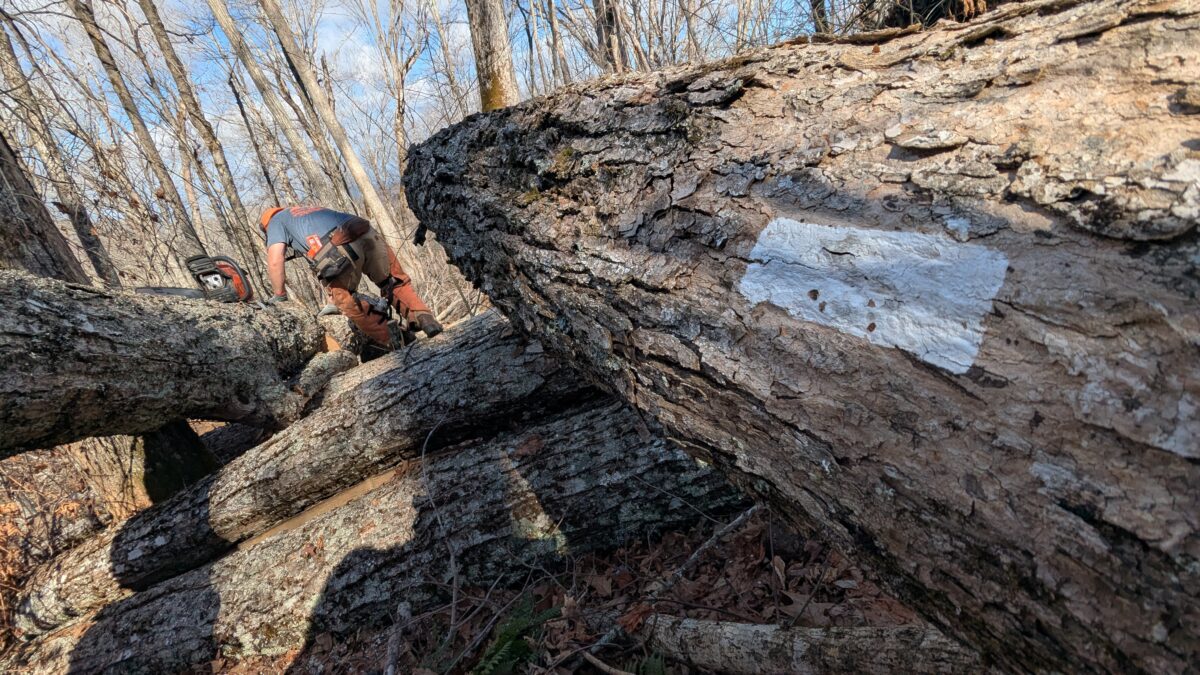
EcoForesters was hired by Conserving Carolina to clear their trail systems in Gerton and the Hickory Nut Gorge area, including Strawberry Gap, Wildcat Rock, Florence Nature Preserve, and Bearwallow Mountain. Along with those, we also cleared a section of the Appalachian Trail near Stinking Creek along the Tennessee border, and many other private and public trails. 

I personally was thrilled to work on these high profile and local trails. I loved hiking the Conserving Carolina trails before the storm, and it was an honor to work on restoring them post-storm. The work was cathartic, being able to repair and return to normality in some capacity. 

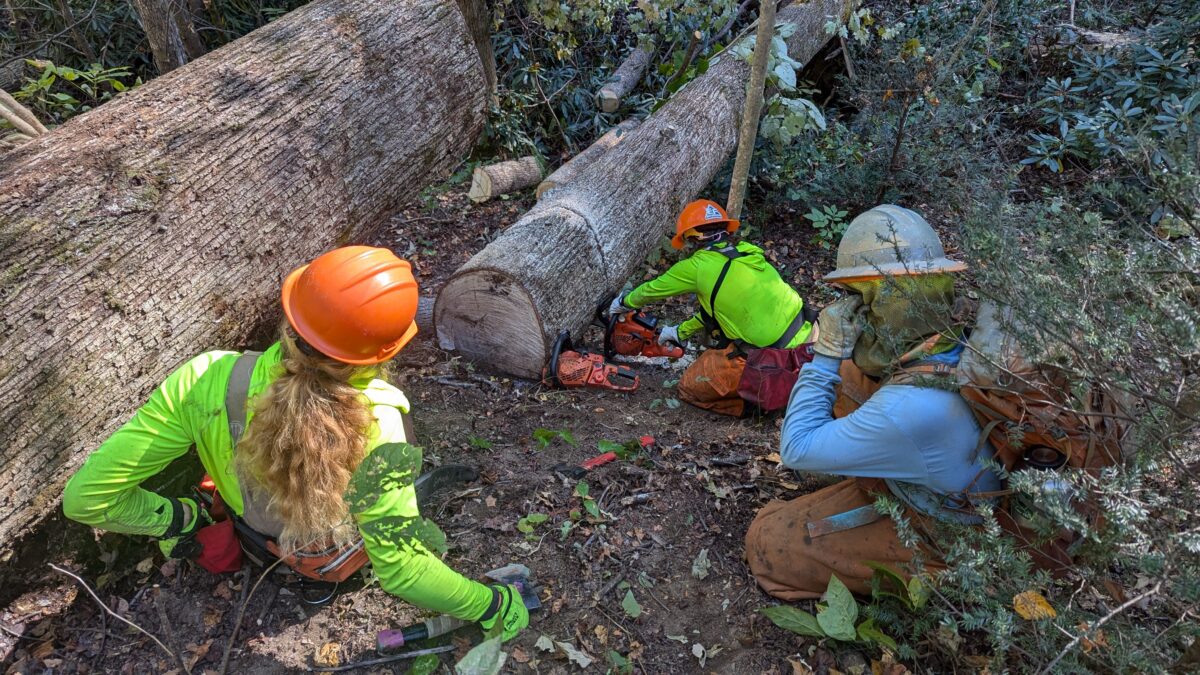
Clearing them meant chainsawing all the trees blocking the trail, moving the cut up wood out of the way, and assessing further trail damage that might need repairing. Crews leap-frogged each other as they made progress. In some cases, the trail was to be re-routed around major damage caused by uprooted trees. At Wildcat Rock, we started at the bottom and had to negotiate a creek crossing, since the trailhead was completely gone. Surprises and complicated puzzles of wrecked trees lay around every corner at all trail systems we encountered. 

Despite all this, the work was hopeful. At a shelter on the AT, the logbook shared inscriptions of adventure and people finding themselves. This adventurous spirit surely lives on, the spring growing season sprouting and blending in the destruction. And the woods still looked great, with many areas untouched. Recreation will live on in our changed environment.

The Right Place at the Right Time

EcoForesters was created for this moment. Our staff is made up of seasoned natural resource professionals who understand the challenges and risks facing the region’s forests. We have identified who needs help and how to help them. We now need your help to put proven outcomes into further action because we are in the right place at the right time.

This newsletter should help you understand what we are up against in response to Helene. Our goal is always to empower landowners to do what they can in support of their forest. But many of the challenges laid out are beyond that goal and will require professional expertise to assess, plan and put into action. Prior to Helene, money was the number one reason that landowners chose inaction and it has only been magnified by this great disturbance.

Our work is funded through a combination of private donations, federal grants, fee for service work and foundations. The current federal funding is no longer reliable, so we will need to make up that difference through our other sources of funding. We also recognize the need to create new funding mechanisms for rural landowners who are either land rich/cash poor or lack the disposable income needed to restore their forests. This landowner base is critical to keeping forests forested and the many benefits like plentiful clean water on the landscape.

We ask that you support our work through a donation of time or talent and share with your friends and family the importance of our mission. The next five years will be spent restoring forests and keeping them resilient in the face of future challenges. Please help us by becoming a member today.

Wildlife Habitat

  • Leave some downed debris on your property (as long as it is further than 30 feet from any structures) to serve as wildlife habitat
  • Manage non-native invasive species in clearings to help promote native plants
  • Plant valuable trees for wildlife such as oaks and chestnuts

Stream erosion/stabilization

  • Plant native, fast-growing grasses (such as annual rye) on bare soil to prevent further erosion
    • In the future, replant these areas with native seeds and woody plants to stabilize them further
  • Livestake with coconut fiber matting to help prevent stream bank erosion

Wildfire/Controlled Fire

  • Implement FireWise practices around your home
    • Clear all downed wood at least 30 feet away from any structures (or further, if your home is on a slope)
    • Consider moving large woody material (over a foot in diameter) up to 100 feet away.
  • Adopt fire-resistant landscaping practices, such as selecting plants with low flammability characteristics
    • Learn more at content.ces.ncsu.edu/fire-resistant-landscaping-in-north-carolina

Invasive Species

  • Learn how to identify non-native invasive plants and tell them apart from native lookalikes
  • Learn and implement common control methods for the species present on your land
  • Landscape with native plants and control NNIS near important native species (such as oaks)
  • For larger infestations, you can get an assessment of NNIS on your property. Contact EcoForesters (info@ecoforesters.org or 828-484-6842) for more information!