Invasive Species
Invasive plants can quickly overtake forests, crowding out native species and disrupting wildlife habitat.
Learn how to identify and manage these threats to help keep our forests healthy and resilient.
EcoForesters Can Help You Fight Your Invasives:
More and more, undesirable species introduced from foreign lands are crowding out native species and even causing local extinctions. EcoForesters provides the service of mapping where these species are, planning for their removal, and then actively removing the species.
Our Non-Native Invasive Species Control Crew was developed to provide landowners an option for ecological stewardship action by improving forest health through invasive species assessments and control. Our crew mechanically treats targeted species predominantly through the use of handsaws and hatchets, with the assistance of herbicides tailored for specific species.
We Can Help You By:
Providing landowners information on how to identify and treat specific species.
Developing a plan for treatments when, how often, and where to begin.
Overseeing and implementing all invasive species treatments on property.
Teaching landowners how to treat certain species on their property through workshops and demonstrations.
For questions or more information, please contact our office to find out how we can help you reduce the amount of invasive species on your forest.
Information and How to Treat Common Non-Native Invasive Species in Western North Carolina
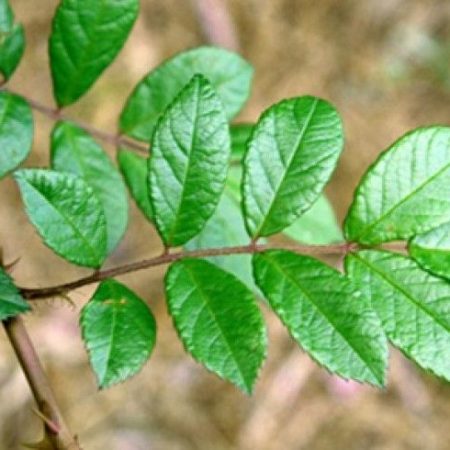
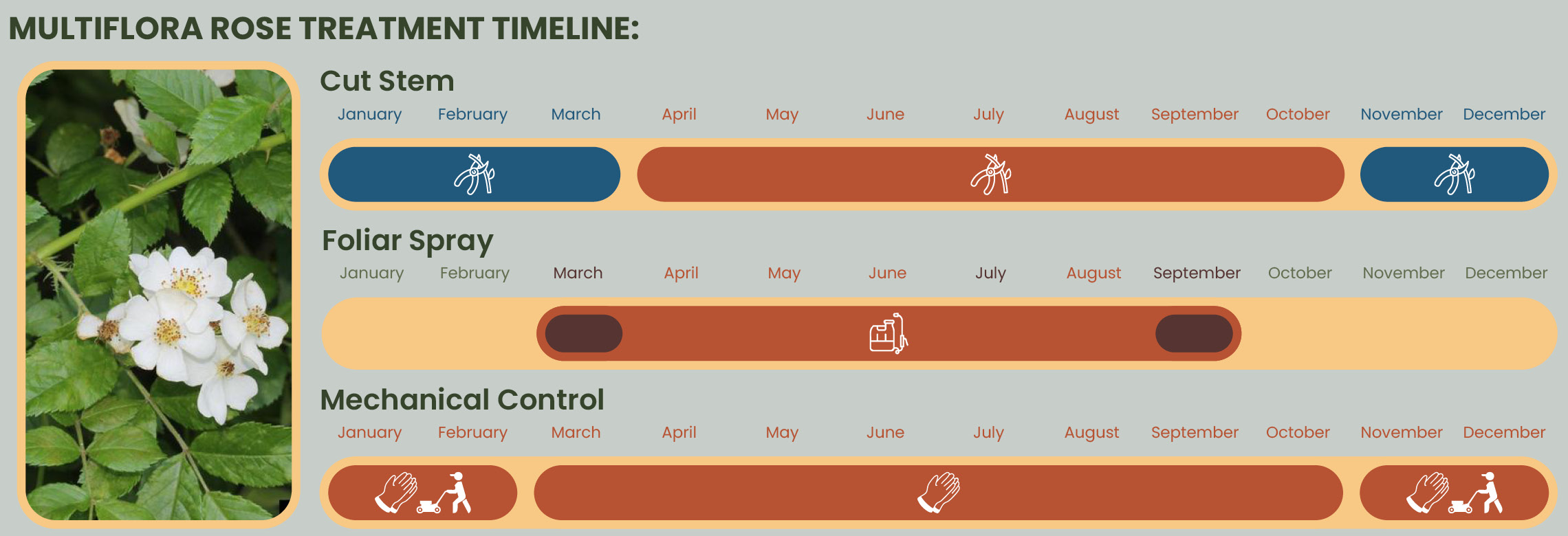
Why is Multiflora Rose a Problem?
Multiflora rose is an invasive woody shrub with sharp thorns that forms impenetrable thickets. Multiflora rose reproduces prolifically by seed, of which a single plant can produce 500,000 each year, and by its stems which can reroot. Plants are often found invading new forests, field and wooded edges, pastures, and right-of-ways.
How to Treat Multiflora Rose:
Hand-Pulling
This treatment is recommended for young plants (with stems shorter than a foot) that have not been established for very long. Use this treatment method March - September
Mechanical Control
If the use of herbicide is not part of the control plan, repeated mowing can be used to keep the plants from producing seed. It is recommended to repeat mowing monthly. Use this treatment method October - April
Foliar Spray
This treatment is most effective while plants are fully leafed, and after the plant has regrown 2-3 feet after mowing. Glyphosate and Triclopyr can be applied at a 3% solution. Use this treatment method July - September
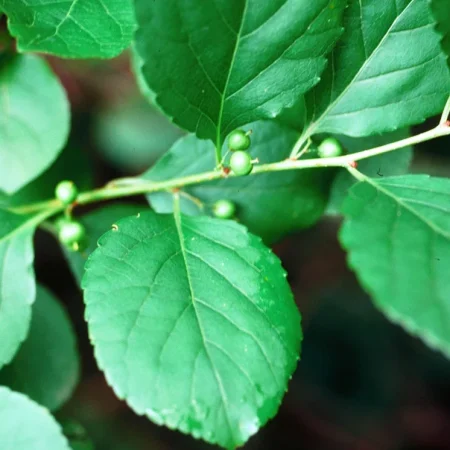
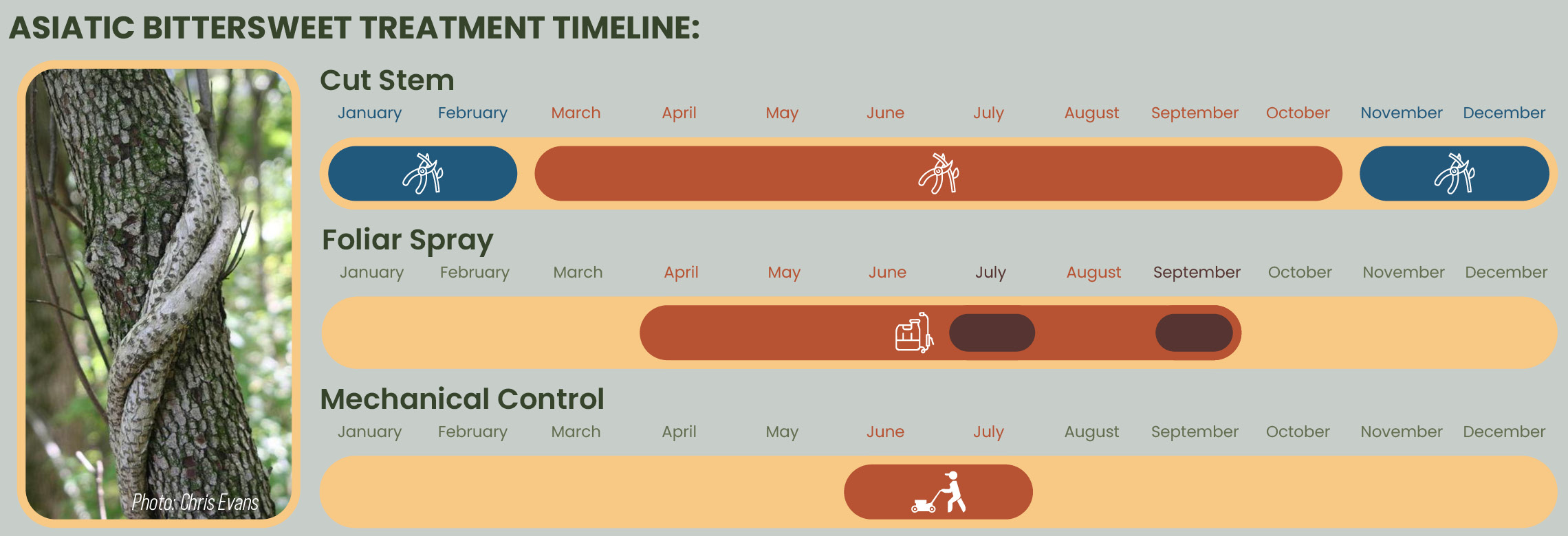
Why is Asiatic Bittersweet a Problem?
Asiatic bittersweet is a deciduous woody vine introduced to the US in 1736 from Eastern Asia. It is best known for its twining and climbing behavior, which allows the plant to climb, suffocate, and strangle even mature trees. It is most commonly found in degraded, early successional habitats such as open woodlands, abandoned fields, wooded edges, and roadsides.
How to Treat Asiatic Bittersweet:
Cut-Stem
This treatment is the most practical and effective way of managing low to moderately severe infestations. A 50% solution of a systemic herbicide can be painted on cut stems to kill the root system. This is most effective while plant are fully leaved. Use this treatment method year round from January - December
Mechanical Control
Seedlings and young plants are easily pulled and removed when the soil is moist. Pull steadily and slowly to minimize soil disturbance. This is a consistent way to monitor for and treat seedling emergence when done routinely. Use this treatment method year round January - December
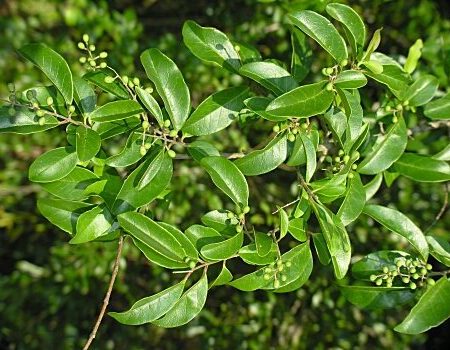
Why is Chinese Privet a Problem?
Chinese privet is a flowering perennial shrub, thought to be introduced in the 1800s as an ornamental plant. It has a tendency to grow in thick, exclusionary hedges up to 30 feet tall that can last up to 40 years. It is often found along fencelines or on the edges of forested areas. As a shade-tolerant species, privets are known for dominating the shrub layer underneath trees, especially in streamside areas.
How to Treat Chinese Privet:
Hand-Pulling
This treatment can be effective for treatment of young privet individuals. Be sure to pull up the entirety of the root system so as to prevent root sprouting. Use this treatment method year round January - December
Foliar Spray
If the privet is below shoulder-height, foliar spray is efficient. Thoroughly wet all leaves with one of the following herbicide solutions in water with a surfactant: Glyphosate mixed at a 3% solution, Imazapyr herbicide mixed at a 1% solution, or Triclopyr 3 mixed at a 3% solution. Use this treatment method year round January - December
Cut-Stem & Basal Bark
For basal bark treatments, apply a 20% Triclopyr 4 solution in basal oil, diesel fuel, or kerosene with a penetrant to the bottom 12-24 inches of bark. For cut-stem, sever the stem at the base and treat the stumps and cut stems with a 20% Triclopyr 3 or 50% Glyphosate solution in water. Use these treatment method December - February
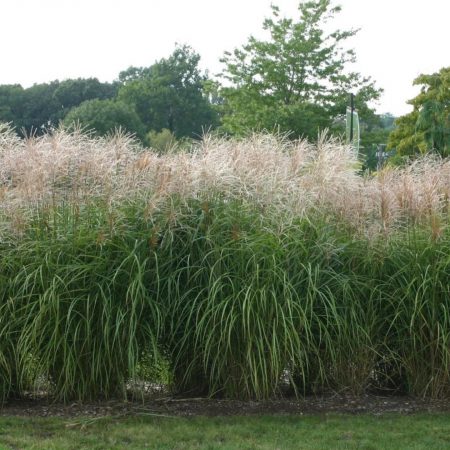
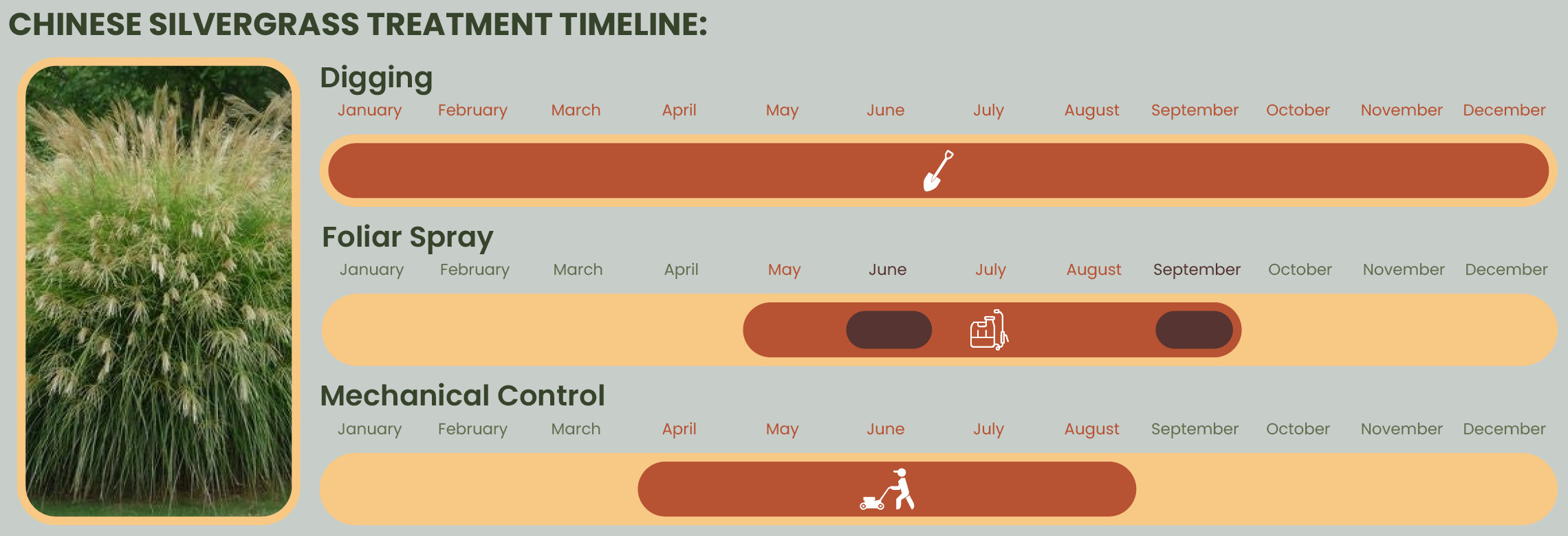
Why is Chinese Silvergrass a Problem?
Chinese Silvergrass thrives in full sun and moist, well-drained soils, making it the perfect candidate to overtake roadsides, abandoned homesites,pasture-land, and forest edges. This plant’s large, tufted flowering stalks can even reach up to 15 feet tall. Its dense clumping form excludes other native grasses, and its extreme flammability drastically increases wildfire risk.
How to Treat Chinese Silvergrass:
Digging
Digging is an option, though it will require diligent monitoring and follow-up. This method is labor intensive, and should only be done after the plants seedheads are gone to prevent spread. Use this treatment method November - July
Foliar Spray
This is the most efficient and safe treatment method, as proper application ensures that the plant dies from its root system and there is little chance of rhizomatic spreading. Use this treatment method in June or late August
Mechanical Control
For basal bark treatments, apply a 20% Triclopyr 4 solution in basal oil, diesel fuel, or kerosene with a penetrant to the bottom 12-24 inches of bark. For cut-stem, sever the stem at the base and treat the stumps and cut stems with a 20% Triclopyr 3 or 50% Glyphosate solution in water. Use these treatment method December - February
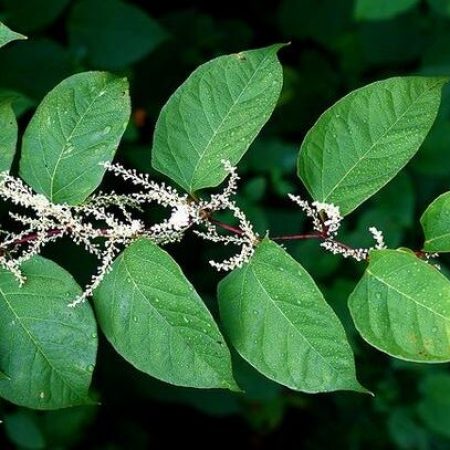
Why is Japanese Knotweed a Problem?
Japanese knotweed evolved to thrive in disturbed areas and can tolerate heavy metals and poor quality soil, allowing it to flourish in degraded environments. It is regarded as one of the worst invasive species on the planet due to its incredible ability to regenerate and spread from tiny pieces of stem. It is most often found along streambanks in both urban and rural areas.
How to Treat Japanese Knotweed:
Foliar Spray
This treatment is the most efficient and safe treatment as it ensures the plant dies from its root system. Applications are most effective when leaves are present and still green. Use this treatment method May - October
Mechanical Control
Due to it’s robust root system and quick re-sprouting response, mechanical control alone is not recommended, but coupling mowing practices with foliar spray treatment 4-8 weeks after the initial mowing is very effective. Cut down all tall stalks and bag them up or burn them on site. Use this treatment method October - July
Cut-Stem
For added control efforts after a mowing and prior to waiting for resprouting before a foliar spray application, a cut-stem application with an herbicide treatment is an option. A chemical cut-stump treatment will weaken the root system but there will likely still be some level of sprouting. Use this treatment method October - July
Digging
Digging out young plants in their entirety is an option, though this will require diligent monitoring and follow-up treatments. Digging out mature infestations is not recommended due to the the interconnected, large root masses that would involve the need for heavy equipment or intense physical labor. Use this treatment method year round January - December
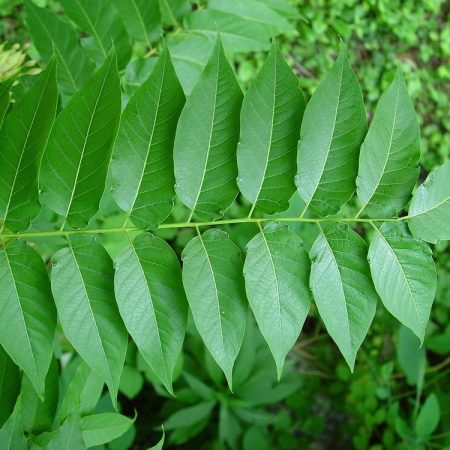
Why is Tree of Heaven a Problem?
Tree-of-Heaven became widespread as an exotic ornamental in public gardens and landscapes. Mature trees can reach 100’ in height and are known for their tendency to spread explosively via seed and root suckers, and female tree can produce 300,000 seeds annually. This species is incredibly drought, wind, pollution, and soil quality tolerant which allows it to grow in nearly any environment.
How to Treat Tree of Heaven:
Hand Pulling
This is an effective method of controlling young trees. Be sure to remove the entire root system if possible, as root fragments left behind can resprout. Use this treatment method July - February
Foliar Spray & Basal Bark
If the Tree-of-Heaven is below shoulder-height, foliar spray treatment is efficient. Thoroughly wet all leaves with a surfactant. Triclopyr is a more effective but Glyphosate may be necessary based on site conditions or time of year. Basal bark treatment can be performed but be cautious with your spray so as to not affect non-target species. Use this treatment method July - February
Hack & Squirt
Make hacks into the cambium layer about 6” from the base of the tree. Leave ~2 inch gap between each hack so as to cripple the tree and not trigger the sucker sprout response as intensely. Repeat treatments will be necessary. Use this treatment method July - February
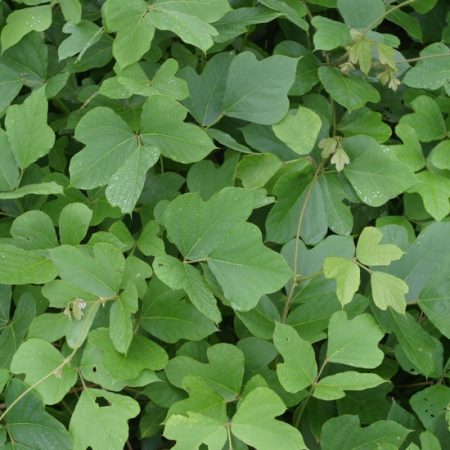
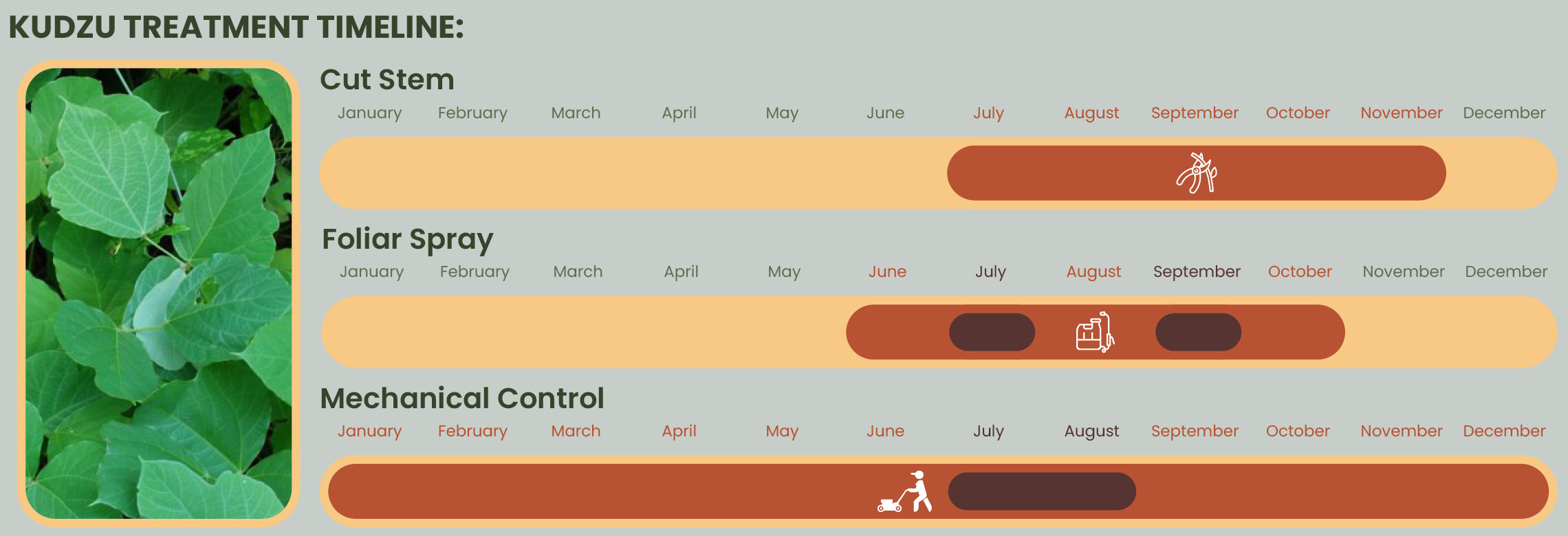
Why Kudzu a Problem?
In the 20th century kudzu became a go-to crop for erosion control and bank stabilization, especially along highways, which contributed to its rapid spread. A single Kudzu plant sprouts as many as 30 individual vines from its root crown, each of which can grow up to 100 feet long with a growth rate as fast as one foot per day.
How to Treat Kudzu:
Foliar Spray
This treatment can be made whenever the vine is growing, when the plants are drawing nutrients to the roots. It should be performed with the legume-specific herbicide Clopyralid. Use this treatment method June - September
Mechanical Control
This method is not particularly effective as it will often resprout. However, using mechanical removal in combination with foliar spraying is an effective treatment method. Cutting the vines that hang off of trees and climb up shrubs or structures can limit the amount of herbicide needed. Use this treatment method year round January - December

Treatment Timelines for Common Non-Native Invasive Species in
Western North Carolina
Effective Treatment Window with Triclopyr 3 or Glyphosate
Effective Treatment Window with Triclopyr 4
Best Time of Year to Treat (If Applicable)