Women in EcoForesters

Women in North America are making large strides in forest land ownership, land management decisions, and natural resource careers. According to ForestHer, a nonprofit dedicated to supporting, educating, and empowering a community of women landowners and natural resources professionals to engage in forest conservation and stewardship in North Carolina, the percentage of family forest ownership where a woman is the primary decision maker doubled from 2006 to 2013, and numbers continue to rise. These women make decisions for 44 million acres of North America’s family forest land.

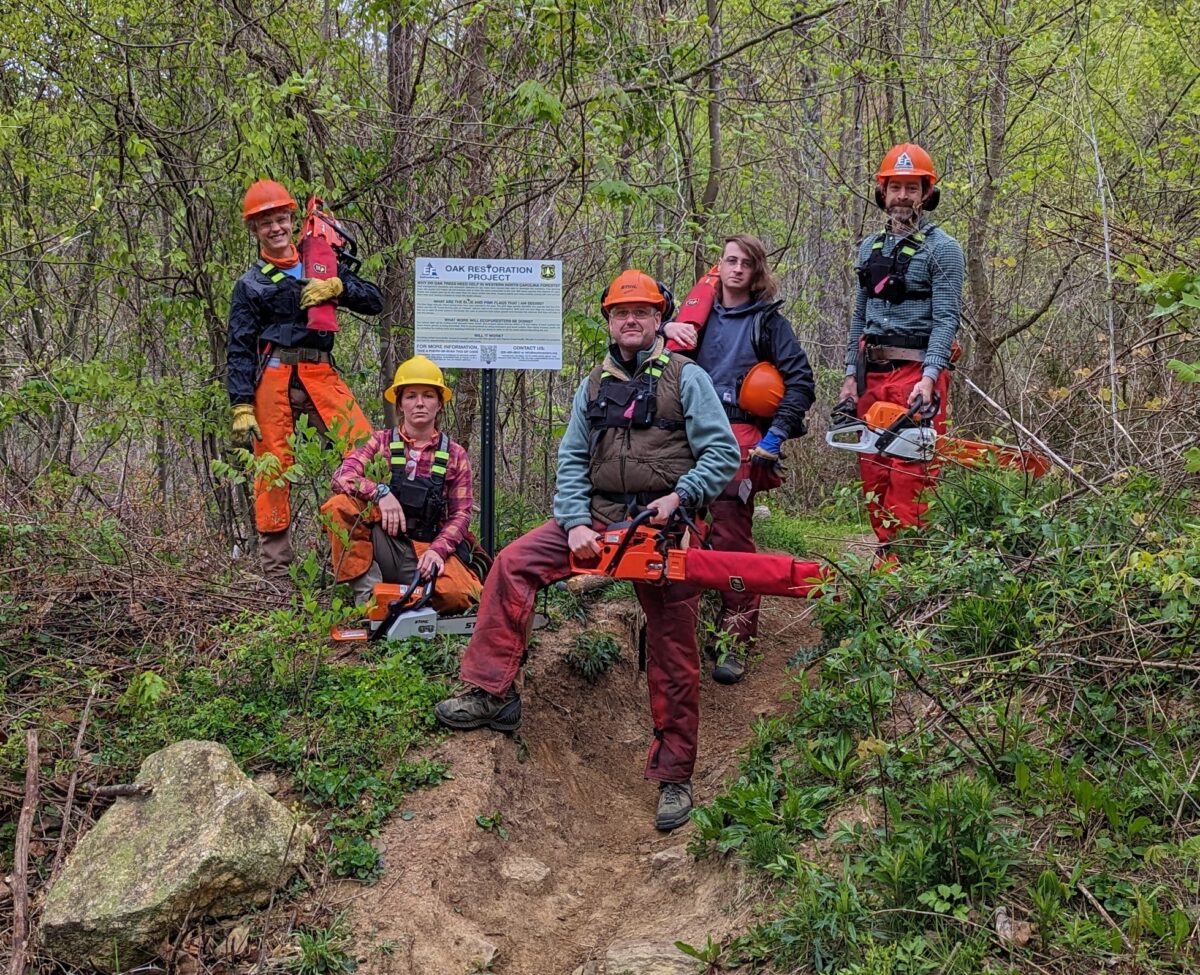
Yet this number still only makes up 16% of family forests–and according to the Society of American Foresters, women make up just 16% of forestry and conservation professionals in the US. With twelve women EcoForesters staff members (46% of staff!) ranging from forestry management, grant writing, GIS map making, to forest restoration technicians, the organization is well positioned to manage the needs of this shifting demographic and see forest management decisions from a woman’s perspective. 
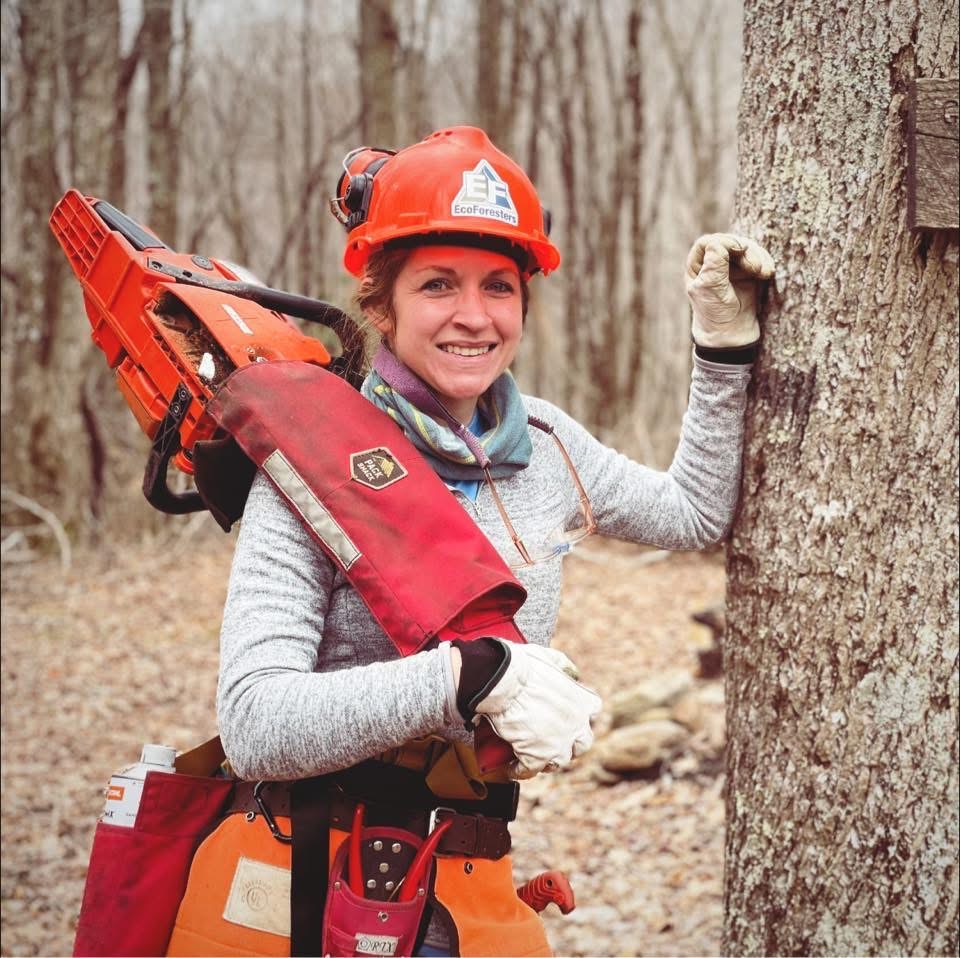
Krishun Karau, Forest Stewardship Director, said lady landowners are welcome at EcoForesters and should not be intimidated when asking for help. 

“I try to assure people, ‘It’s daunting for everybody.’ Specifically, land and invasive plant management. It’s science and ecology, that sort of stuff can be over everybody’s head,” she said. “My advice is to get out there and get comfortable with your land. If you have the means, hike around, get yourself familiar with the plants.”

According to the National Association of State Foresters, women began making inroads into forestry during World War II, when they stood in for men on fire crews and cruised timber as well. But it wasn’t until 1978 that women were officially allowed to work for the US Forest Service. In 2007, the Forest Service named its first female chief, Gail Kimbell.

“If you have the physical ability to get outside, I don’t think you should be dissuaded by your gender or your sex,” said Karau. “A lot of the tools we use at EcoForesters can be used by anyone as long as you are able-bodied.”

Kelly Waldron, Assistant Stewardship Director, spoke a little on the challenges she faced at the start of her career. “There were a couple instances early on in conservation work where a couple of folks underestimated how strong my back was. [I was determined] to prove them wrong when it came to lugging locust logs from some trail building.”
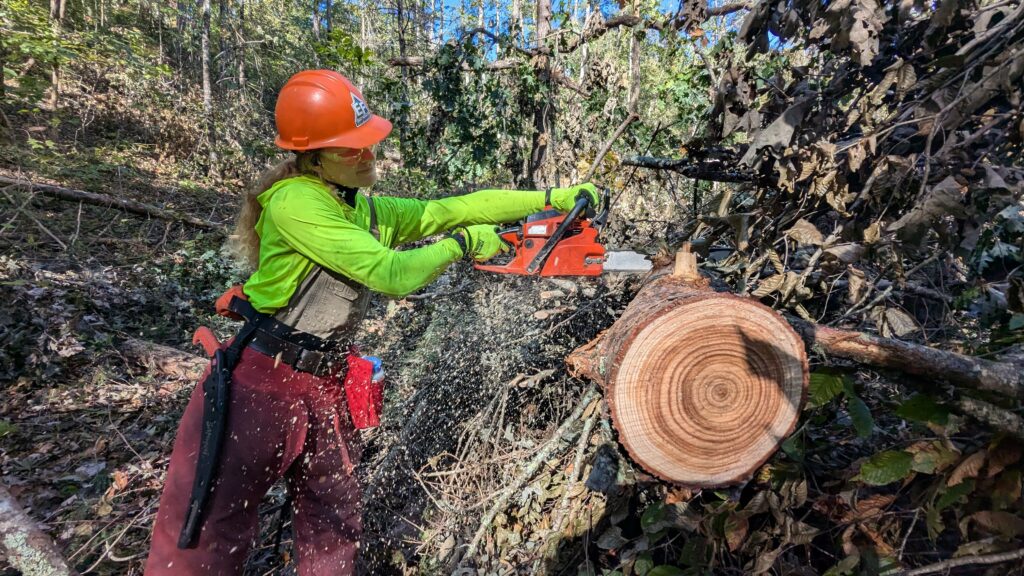
Karau acknowledged that there may not be so much as a physical barrier to using tools such as chainsaws and backpack sprayers for women. “It’s like an invisible barrier of maybe not feeling welcome, or feeling like I don’t want to ask a dumb question or be spoken down to. It’s a matter of finding people who are patient and who are willing to teach you, regardless of your gender.”

On a personal level, Karau oversees the field crew at EcoForesters, managing schedules, performing forestry consultations, running educational workshops, and joining the crew to perform all the services that EcoForesters offers. She said she does see the field of forestry as changing and becoming more accepting of women.

“I feel lucky to have had an overall positive experience working in natural resources,” said Karau, who went to college from 2008-2012. “It wasn’t that long ago, but it was mostly men in my program for natural resources. For me, it was a rise to the challenge type thing: I can do this too. It has been an uncommon thing for me to feel like I was being dismissed because I’m a woman. There’s a sense that you have to prove yourself, and you have less of a margin for error because you don’t want to perpetuate the stereotype that women are incapable of doing this work.” 
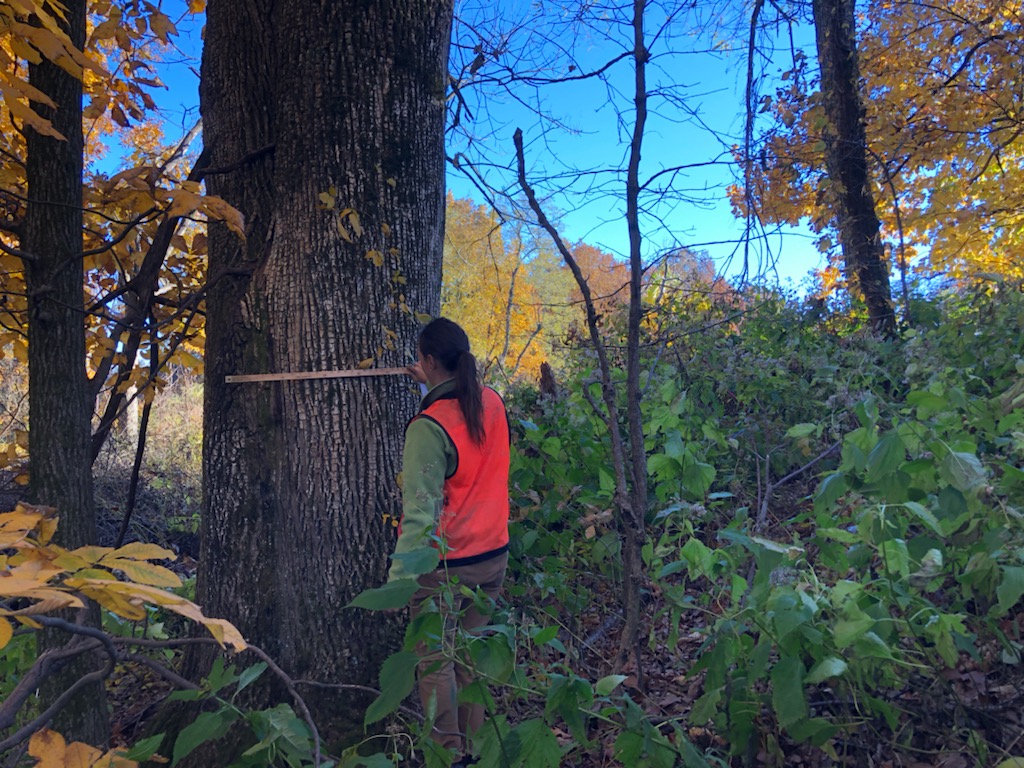
Karau lauded all the EcoForesters work partners who have helped restore local forest habitats. “This industry has become more accepting toward women, and I don’t get that feeling [of being dismissed] that often anymore. With EcoForesters, all of the project partners and landowners I’ve worked with have been really awesome and inclusive. Folks are just generally happy to have someone come to their property and talk to them about the things they care about.”

Resources are on the rise for female landowners. The Natural Resource Conservation Service (NRCS) is an agency of the US Department of Agriculture that provides assistance to farmers and other landowners. The NRCS offers an Environmental Quality Incentive Program (EQIP), which has a higher reimbursement rate for historically underserved populations, and female landowners fall under that category.

 “It’s awesome, the government is looking to help people who haven’t historically had a leg up in terms of land ownership,” said Karau. 

For women looking to enter the conservation field or become more active in their forestland, Waldron says to just go for it! “Take any opportunity to get out in the field and try various types of conservation work. Be curious! Ask questions! Who cares if you’re 17, or 37, or 62? We need [more] active stewards, because it takes a village.”

Resources: Women Owning Woodlands Network and ForestHer. Skills Academy for Women.

EcoForesters Restoration Crew

The forest restoration crew comprises a good chunk of the staff of EcoForesters. They are responsible for field operations such as invasive species removal, forest stand improvement, trail building, and, after Helene, trail and land clearing and erosion control. Over the past ten years, the restoration crew has evolved significantly–from a small crew with a small scope of operations, to a large crew operating out of three trucks and a new UTV for hauling gear and delivering herbicide to large problem areas. 

Helene introduced many opportunities for restoration: bare soil was exposed, and trees were downed and tossed in front of trails. As any local can attest, it was a mess, and habitats needed help. 

At a property that EcoForesters has worked on for years in Yancey County, a debris flow was measured at 4,900 feet long, leaving a long scar down the mountain–rocks tossed aside, the bedrock exposed. There was much work to be done, but the landowner, Russ Oates, was organized, up for the challenge, and had a plan. Thankfully, his house and his tree planting project were left intact from the wicked rain event. 

Hundreds of trees in the path of the debris flow, however, were tossed aside on the steep property, widening the shaded mountain stream into a light brown canyon. The light was let in, creating an opportunity for regrowth, but it was important to act quickly before undesirable species moved in. 

This spring, EcoForesters crews implemented a plan to plant different species of rye grass on the exposed dirt, controlling erosion and getting a base layer of vegetation down. All of the soil was covered in seed, all the way to the steep, rocky top of the flow. This winter, hundreds of oaks and hickories will be planted, replacing the trees lost and hopefully restoring the habitat.

In Fairview, a similar situation unfolded at a rich cove forest property. EcoForesters’ crews had been treating the steep property for years and had made great headway, with hardly any invasives remaining. But Helene caused several moderate debris flows that exposed the dirt. 

After an assessment and mapping of the problem areas, the strategy decided upon was to cover the debris flows in eco-friendly Coir matting, an erosion control solution that is made from coconut husks. The mats resemble cargo nets and are staked into the earth, where they are covered in seeds and biodegrade over the years. Installing the matting turned the bare earth patches, susceptible to more erosion and invasive infestation, into a stakehold of desirable plants that will re-stabilize the slope. 

One year after the devastation of Helene, the challenges are still unfolding, and the aftermath is still being studied. EcoForesters is committed to evolving and facing these challenges.

How it all Started

By Rob Lamb – EcoForesters Founder

After 10 years of creativity, vision, and dedication, it is time to reflect and celebrate EcoForesters’ 10th birthday! Thanks to the hard work of our staff and board–and the incredible support we’ve received from donors, landowners, and conservation partners–EcoForesters has become an innovative leader in forest conservation and restoration. I hope this article provides a deeper understanding of why EF is an essential organization that needs your ongoing support to achieve our mission. In 2026, we will roll out our vision for the next 10 years of EF’s work. If you’re impressed with what we’ve done so far…you ain’t seen nothing yet!

Appalachian Forests: Amazing and Integral

Appalachian forests are, without a doubt, among the world’s greatest natural resources. Among the oldest mountain chains in the world, our forests are a spectacular life force of green, harboring abundant wildlife and intense biodiversity, deep nutrient-rich soils, a massive source of clean and cool air, and abundant crystal clear water. Appalachian forests and harvested wood products store the equivalent of 19 years of all CO2 emissions produced across the states. Nearly 10,000 species are known to inhabit the Southern Appalachian region alone, and it hosts the highest aquatic biodiversity in North America.  

Appalachian forests are the playground for millions, leading to billions of dollars in tourism and outdoor recreation, while the Appalachian forest products industry is another multi-billion-dollar business. Millions of jobs depend on a vibrant and sustainable Appalachian forest. In addition to being a main source of our income, they literally provide us with the air, water, food, and shelter we need to survive. 

Putting the importance of our forests into view provides perspective on the value of EcoForesters’ mission. Sustaining our forests is foundational and essential for our very survival. The work EcoForesters does each and every day, thanks to your support, helps sustain us and future generations. 

Why I Started EcoForesters

From a young age, I was able to develop a personal relationship and appreciation for these forests. What started with family backpacking trips in the North Georgia mountains ultimately led to a 2,000-mile thru-hike of the Appalachian Trail in 2001, a master’s degree in forestry in 2005, and the start of a forestry career in Western North Carolina in 2006. Until 2014, I worked as a forestry consultant for hundreds of landowners, visiting tens of thousands of acres. There, I learned firsthand the untold story of Appalachian forest degradation beneath the green forest canopy.

It is easy to take Appalachian forests for granted. They’ve always been there, and any changes typically happen slowly and can be virtually imperceptible to us in our busy lives. But to understand trees and forests, we have to think in terms of decades and even centuries. Taking this into perspective, our forests have been resilient against massive assaults at our hands. Appalachian forests today bear the scars of mass clear-cutting at the turn of the 20th century, a legacy of high-grading and industrial forestry over the past 70 years, the introduction and spread of exotic invasive plants and diseases that have wiped out integral tree species and halted forest regeneration, and urban sprawl that fragments forests into more edge habitat of diminished health. An early EcoForesters employee coined a common saying amongst our staff these days: “Just because it’s green, doesn’t mean it’s healthy.” While each individual patch of forestland may still be full of life, when looking at Appalachian forests at a large scale of space and time, we see that our forest is losing its capacity to regenerate itself and is providing diminished benefits in wildlife habitat, biodiversity, clean air, and clean water. 

I became keenly aware of this reality while working as a forestry consultant for nearly 10 years. Time and time again, I saw degraded forests at risk of regenerative failure from past abuse and invasive plants and insects. I came to understand that both the prevailing conservation mindset of preservation, as well as the for-profit forestry model, were failing forests and landowners alike, inadequately structured to meet their needs. Small private landowners own approximately 70% of Appalachian forests, yet without appropriate public and professional support, their forestland (and the forests everyone depends on for clean air and clean water) will continue to degrade.

The days of standing by and letting “nature take its course” would not provide the outcomes we need to survive. Likewise, looking at our forests for short-term profit from forest products would continue to degrade them. Rather, we needed to invest in the restoration of forestland. We must engage as active stewards of our forests and restore forestland, acre by acre, working landowner by landowner, so that forests can regain their capacity to maximize ecological benefits for all.

The solution: a non-profit professional forestry organization with a forest conservation and restoration mission, a mission aligned with the goals of so many landowners who desire to sustainably steward their land. While there were some conservation non-profits that advocated for good forestry, few were staffed with expertise in forest management, and none were actually capable of doing the work. With no proven model for success, starting this organization would be pioneering a new, yet essential path for the future of our forests; so nearly 10 years ago, I founded EcoForesters.

EcoForesters: Years 1-10

Ten years later, I think it’s safe to say that EcoForesters has been a tremendous success. Our success has not been linear, and while we’ve had our ups and downs, our overall growth and impact have been exponential. Our staff and subsequent impact have doubled roughly every 2 years. The results: long-term stewardship care on over 250,000 acres and with over 600 landowners, over 10,000 landowners engaged via outreach or direct consultation, invasive species controlled, and forest restoration on over 3,000 acres (including over 500 acres on permanently protected conservation lands), and a staff that has grown from 2 in 2015 to 26 in 2025.

Having multiple funding sources helps increase our stability and impact. EcoForesters channels private donations towards landscape restoration planning, stewardship on permanently protected land, and our outreach and education programs, while our direct forest stewardship work is funded by a combination of grants and investment from forest landowners themselves.  When you look closely at the relative investment of funds, our impact is even more impressive. For example, $250 would help us reach over 500 landowners, conduct stewardship planning on 10 acres, or invasive plant control on 1 acre. While permanently protecting land is an important part of overall conservation, the vast majority of forestland remains in the hands of private landowners. If conservation funding isn’t adequately channeled to this land base, then the risk to the future of our forests will substantially increase.

Much of forest conservation funding today is funneled towards reducing climate change and increasing ecosystem services. Here too, EcoForesters has an outsized impact. Through internal studies and forest growth modeling, we’ve found that over 10-30 years, forests where we’ve controlled invasive plants sequester 1 additional metric ton of carbon dioxide per acre per year than if the same forest had gone untreated. So far, the work of our forest restoration crew has led to an additional 3,000 tons per year of carbon sequestration, a number that will greatly increase in the years to come as we continue our work. Our sustainable forest management practices that mimic natural processes, promote species diversity, and retain healthier trees also lead to significantly more carbon storage. While there is currently no carbon offset market that sufficiently incentivizes landowners for this kind of work, EF is working with landowners to do the work anyway, leading to real additional carbon sequestration to mitigate climate change. 

After 10 years, EcoForesters has proven it is a model organization that can sustainably grow and replicate to positively impact forests at a landscape scale, demonstrating the essential path we must take to sustain forests and the benefits that forests provide. Over the years, our effectiveness has been increasingly recognized by countless landowners, public and private conservation partners, and significant funding opportunities. As a result, EcoForesters in 2025 is a rapidly growing organization that is highly effective in leveraging available resources to achieve the greatest impact towards its mission. 

Join EcoForesters for the next 10 years and beyond

The next 10 years are of outsized importance in determining the future of our planet. No individual conservationist, organization, or government is going to make the difference in stemming the impact of climate change and conserving forests, biodiversity, clean water, and wildlife for future generations. It will undoubtedly be a group effort. What I can say with the utmost confidence is that EcoForesters is a key cog towards achieving local and global conservation goals. As we celebrate our 10th birthday, our work is just beginning, and we are positioned to replicate our model and extend conservation and stewardship to make what we’ve achieved so far seem like a drop in the bucket. 

Our staff works tirelessly because they understand the importance of our work. If you are reading this article, you also understand and are committed to EF’s work. And for those that don’t yet know about EF, they are also a part of our greater forest ecosystem. The question is: how will we proceed? Can we sustain our forests and the benefits they provide? The answer: we can and will sustain our forests, and we will do it using EcoForesters as a model. We have a plan for the next 10 years, and it depends on your support! What part will YOU play in sustaining our forests?