This year has been filled with a wide range of emotions for EcoForesters staff. While we’re proud of our ten years in existence and the difference we’re making in the field of forestry, we are heartbroken on a weekly basis as our staff witnesses the damage still visible from Helene. We are reminded daily that our mission to restore and conserve forests is site-specific, and in some cases, it means asking people to be patient. If you have dealt with the destruction of your forest, the loss of or damage to your home, and countless unplanned expenses, being told to be patient can be hard to hear.
I am in my sixth year at EcoForesters. As a non-forester, I continue to learn from my colleagues that change happens incrementally and often undetected. The fruits of today’s decisions are often not realized until decades later. And the ability to capitalize on those decisions–for instance, through a timber harvest–can be wrecked in the blink of an eye (or storm). Many landowners who had the security of a future timber harvest that could help pay for college tuition, retirement, or an unexpected health expense are now realizing that opportunity is gone. This loss was paired with damage to their forest that must be accounted for, often at an expense. It was quite the turn of events for thousands of people.
We are also reminded daily that we don’t have all of the answers. Many problems will require funding to offset the costs of debris removal or wildfire mitigation. Figuring out how to restore and regenerate 800,000 acres of storm-damaged forest is a first for this region, but the solutions we’re discovering are already being put into action. Through the help of agencies, NGO partners, and tenacious landowners, we are providing helpful advice and action that reduces risk and takes another step toward future forest health.
With the reduction in agricultural and forestry agency budgets and staff, we will see a reduction in capacity from the people best suited to help. The unforeseen costs for landowners due to Helene are still being realized, meaning that important restoration and regeneration work will be neglected to pay for more immediate needs. A year after this storm of the century, one thing is clear: assistance in the form of professional expertise will be essential, and we will need creativity to help fund the work that must be done.
Despite the difficulties of the last year, we still have much to celebrate after a decade of EcoForesters. Our mission is needed, and our methods are working. We hope you will continue to stay interested and supportive of our work for the next ten years. Thank you for sticking with us!
The devastation that Hurricane Helene caused will be felt for untold years, among that being a large influx of downed trees of all sizes and species. Landowners have no doubt noticed the increase in coarse woody material deposited on the forest floor. While some may consider it unsightly, it’s important to look at the fallen trees through an ecological lens and recognize the positives this glut of material can offer the forest habitat.
We talked with Joey Borders, Forester with EcoForesters, for his take on what the storm aftermath means for organisms large and small. He explained that a natural forest is a shifting matrix of successional stages, with historical storm disturbances shaping the forest.
“What we have now in the modern era is second or third growth forests that have been shaped by logging. Trees are all cut at once, resulting in a continuous canopy that has been in place for decades, and an altered understory that lacks structural diversity,” he said.
When Helene knocked down so many trees, it tipped the scales in favor of a more natural forest that provides habitat for all organisms in the food chain. The coarse woody material (not debris) provides mulch that regulates moisture on the forest floor, fertilizer for emerging plants, and habitat for everything from insects, rabbits, rodents, snakes, ground nesting birds and woodpeckers looking for meals in snags. This woody material was greatly lacking before the storm, and now the needle has been greatly turned the other way, providing an opportunity for the food chain to thrive.
“In terms of establishing historical conditions, this kind of disturbance is representative of these stand replacing disturbances that we often talk about that have historically shaped our forest. In that regard, that would be a positive,” said Borders. “There are opportunities that come out of an event like this.”
Species that thrive in early successional habitats like ruffed grouse, golden-winged warbler and even deer and foraging ungulates will have increased habitat to explore, said Borders.
“As the forest grows in, there will be shrubs and herbaceous species that thrive with the increased spatial and light resources, all species that either forage or nest in those circumstances will have an advantage,” said Borders.
Since our forests have been greatly shaped by human influence, there are risks to just walking away and allowing them to naturally regenerate. Non-native invasive species have a chance to explode in the sunlight. Borders also said that since the forests have had a consistent canopy for so long, mesic species (ones that thrive in more moisture) have an advantage over others.
In terms of dealing with fallen trees in a landowner’s forest in the most ecological way possible, non-traditional forest products such as cultured mushrooms on logs are a great ingredient in the mix. Borders said that a diversity of thinking will be required, with a mix of using the logs and mitigating fuels that should be a concern.
“Salvage logging is an option that I think is appealing to a lot of people because it allows you to offset some of the cost of managing those fuels, but there’s an increasingly limited window we have to salvage logs. There’s only going to be a few more months where it’s reasonable to get merchantable timber,” he said.
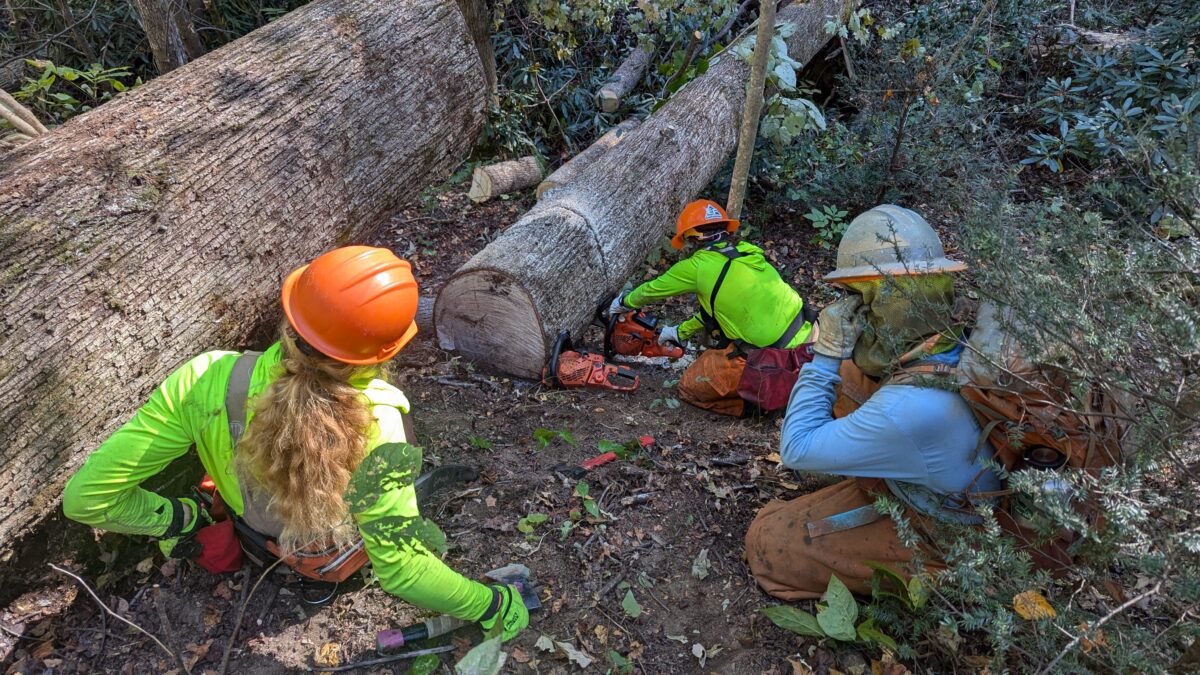
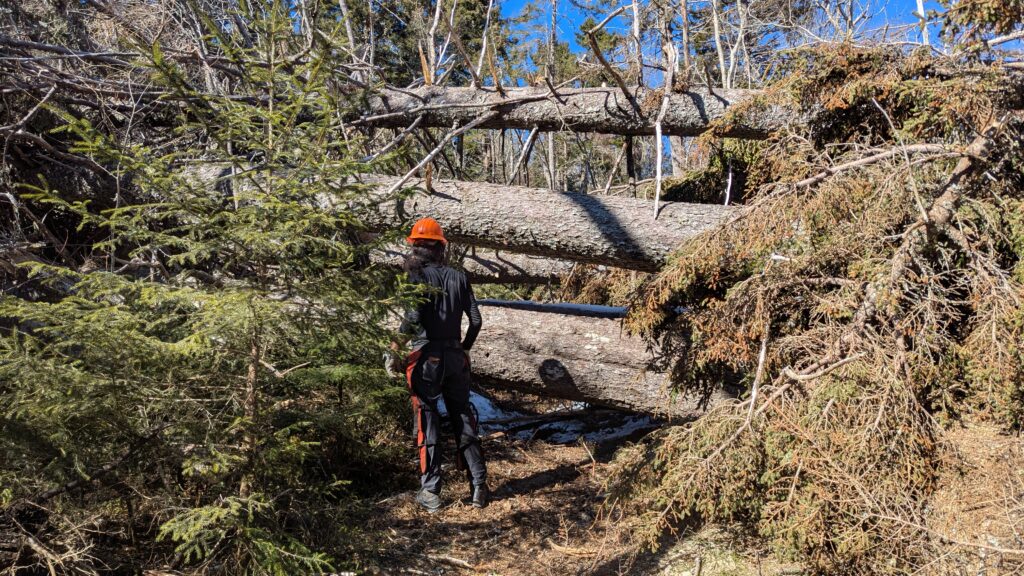
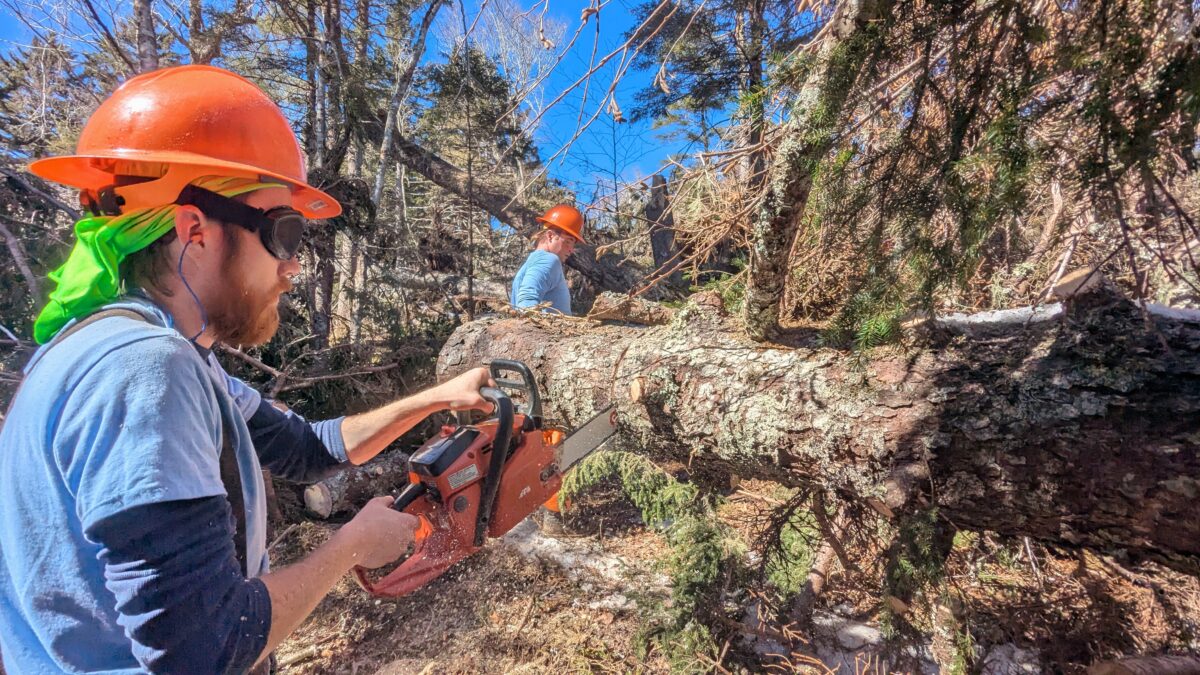
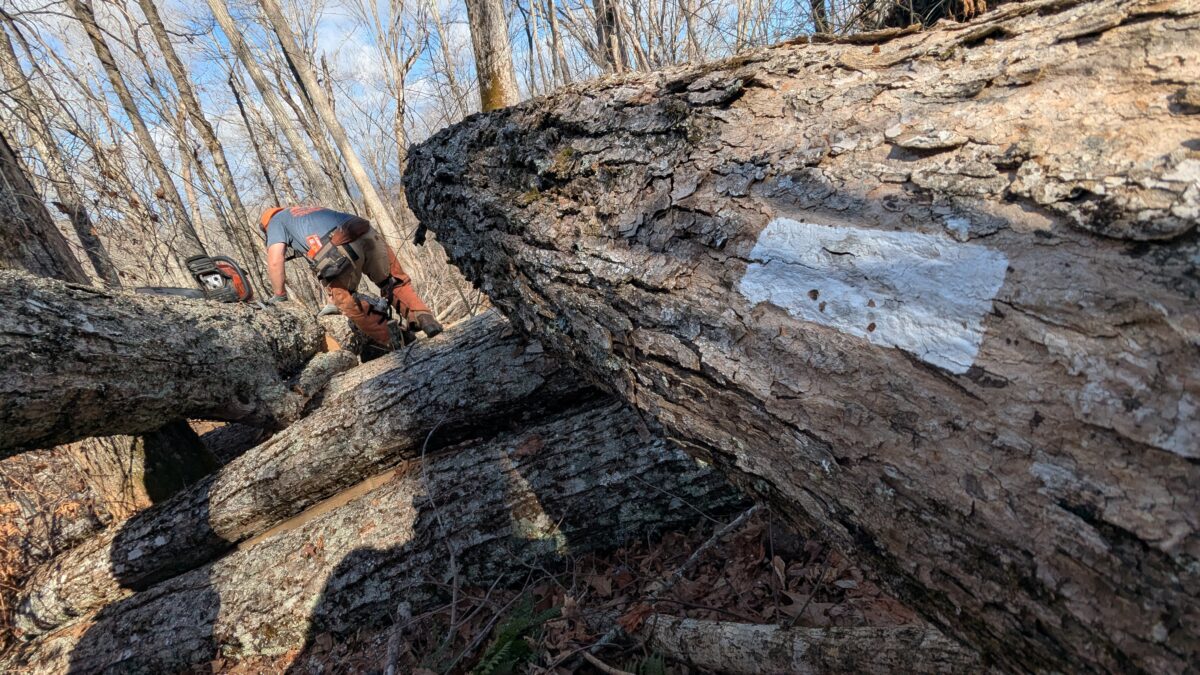
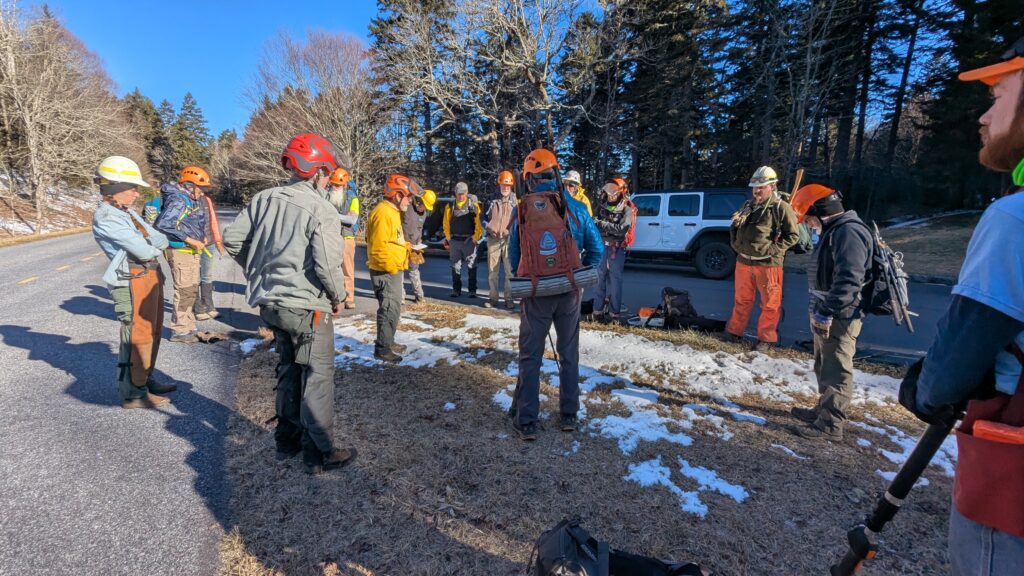
The snow hissed as it touched the hot exhaust on my chainsaw. It was February 24, and I was crawling under a fallen pine on the way back to the EcoForesters truck, parked at the Big Butt trailhead on the Blue Ridge Parkway. Our crew had just worked with the U.S. Forest Service and volunteers of the North Carolina High Peaks Trail Association to clear as much of the trail as we could in a day. We encountered walls of large trees. It was a mess.
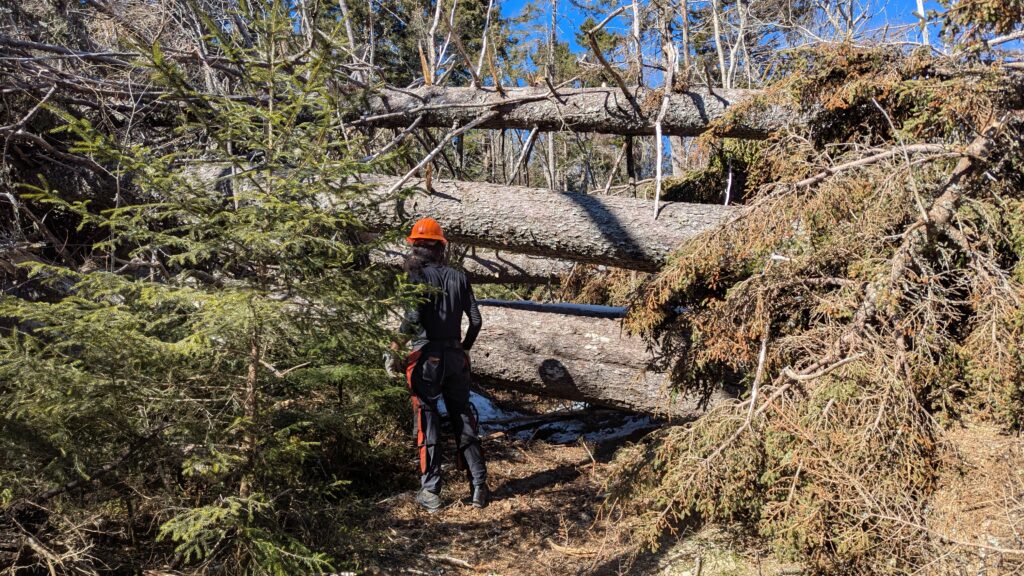
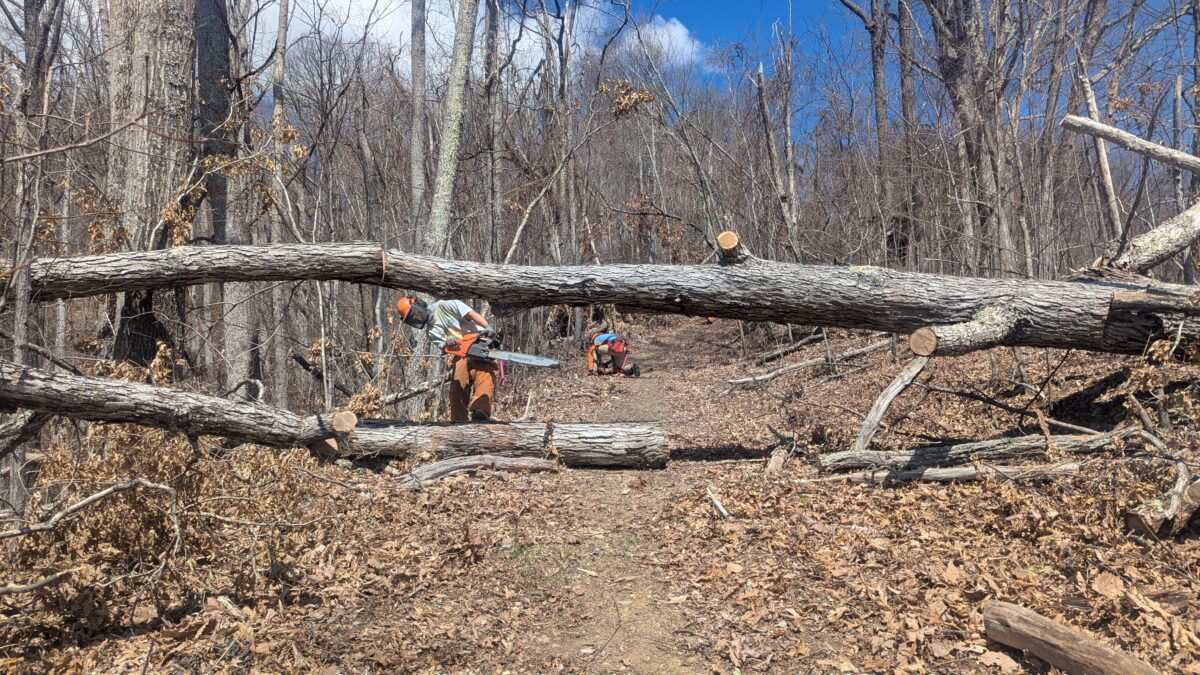
After Helene hit, the usual once in a while log blocking a trail had become many fallen trees, some stacked on top of each other, blocking numerous parts of trails. Big root balls towered into the air, with the corresponding hole sometimes exploding a trail like World War 1 artillery fire. Trees were twisted from tremendous wind force, the tops broken off and tossed down the mountain.
The damage seemed random, with many peaks left untouched, and bowls full of downed trees. It was as if the wind accelerated down the mountain, twirling and gaining speed in certain coves. You don’t have to hear it from me if you’re a local, but downed trees in the woods were no longer a spectacle, they were the norm.
EcoForesters was hired by Conserving Carolina to clear their trail systems in Gerton and the Hickory Nut Gorge area, including Strawberry Gap, Wildcat Rock, Florence Nature Preserve, and Bearwallow Mountain. Along with those, we also cleared a section of the Appalachian Trail near Stinking Creek along the Tennessee border, and many other private and public trails.
I personally was thrilled to work on these high profile and local trails. I loved hiking the Conserving Carolina trails before the storm, and it was an honor to work on restoring them post-storm. The work was cathartic, being able to repair and return to normality in some capacity.
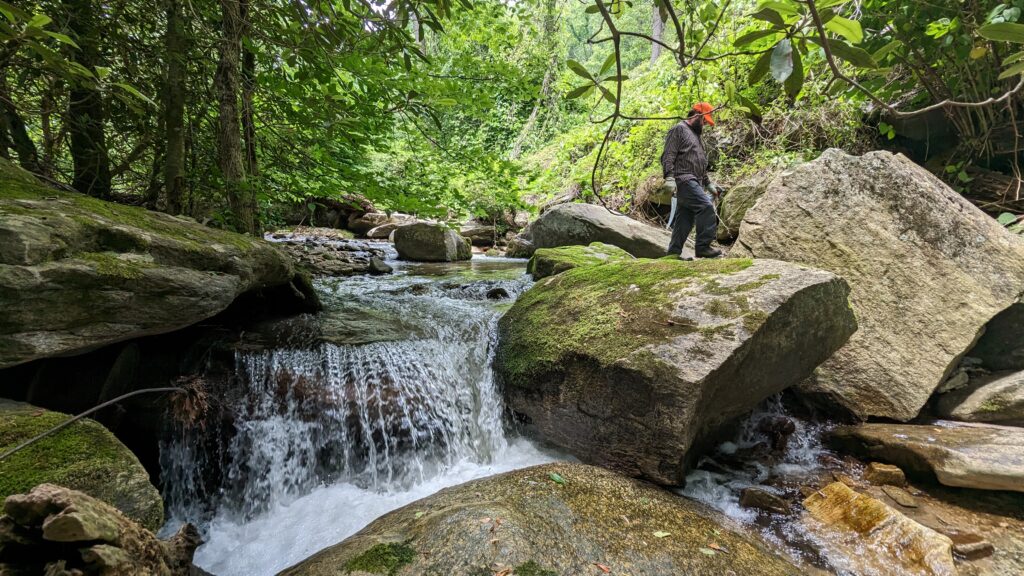
Clearing them meant chainsawing all the trees blocking the trail, moving the cut up wood out of the way, and assessing further trail damage that might need repairing. Crews leap-frogged each other as they made progress. In some cases, the trail was to be re-routed around major damage caused by uprooted trees. At Wildcat Rock, we started at the bottom and had to negotiate a creek crossing, since the trailhead was completely gone. Surprises and complicated puzzles of wrecked trees lay around every corner at all trail systems we encountered.
Despite all this, the work was hopeful. At a shelter on the AT, the logbook shared inscriptions of adventure and people finding themselves. This adventurous spirit surely lives on, the spring growing season sprouting and blending in the destruction. And the woods still looked great, with many areas untouched. Recreation will live on in our changed environment.
EcoForesters was created for this moment. Our staff is made up of seasoned natural resource professionals who understand the challenges and risks facing the region’s forests. We have identified who needs help and how to help them. We now need your help to put proven outcomes into further action because we are in the right place at the right time.
This newsletter should help you understand what we are up against in response to Helene. Our goal is always to empower landowners to do what they can in support of their forest. But many of the challenges laid out are beyond that goal and will require professional expertise to assess, plan and put into action. Prior to Helene, money was the number one reason that landowners chose inaction and it has only been magnified by this great disturbance.
Our work is funded through a combination of private donations, federal grants, fee for service work and foundations. The current federal funding is no longer reliable, so we will need to make up that difference through our other sources of funding. We also recognize the need to create new funding mechanisms for rural landowners who are either land rich/cash poor or lack the disposable income needed to restore their forests. This landowner base is critical to keeping forests forested and the many benefits like plentiful clean water on the landscape.
We ask that you support our work through a donation of time or talent and share with your friends and family the importance of our mission. The next five years will be spent restoring forests and keeping them resilient in the face of future challenges. Please help us by becoming a member today.
Wildlife Habitat
Leave some downed debris on your property (as long as it is further than 30 feet from any structures) to serve as wildlife habitat
Manage non-native invasive species in clearings to help promote native plants
Plant valuable trees for wildlife such as oaks and chestnuts
Stream erosion/stabilization
Plant native, fast-growing grasses (such as annual rye) on bare soil to prevent further erosion
In the future, replant these areas with native seeds and woody plants to stabilize them further
Livestake with coconut fiber matting to help prevent stream bank erosion
Wildfire/Controlled Fire
Implement FireWise practices around your home
Clear all downed wood at least 30 feet away from any structures (or further, if your home is on a slope)
Consider moving large woody material (over a foot in diameter) up to 100 feet away.
Adopt fire-resistant landscaping practices, such as selecting plants with low flammability characteristics
Learn more at content.ces.ncsu.edu/fire-resistant-landscaping-in-north-carolina
Invasive Species
Learn how to identify non-native invasive plants and tell them apart from native lookalikes
Learn and implement common control methods for the species present on your land
Landscape with native plants and control NNIS near important native species (such as oaks)
For larger infestations, you can get an assessment of NNIS on your property. Contact EcoForesters (info@ecoforesters.org or 828-484-6842) for more information!
Ecoforesters has done amazing things to help streams recover on my projects at Wildlands Engineering. They have helped reduce invasive species pressure on riparian reforestation, an important step in stream and wetland mitigation projects. Reforestation supports the goal of maintaining shaded streams and stable banks. Our projects enjoy reasonable funding and benefit from the input of a diverse group of professionals through the phases of planning, design, implementation, and maintenance. For landowners of working lands in agriculture or forestry, resources for stream management can be more constrained and streams can present significant management challenges, especially in the aftermath of Hurricane Helene. Streams are resilient, but recovery takes time.
Rather than try to address frequently asked questions on stream recovery the goal of this article is to establish a stronger base of understanding in dealing with streams and to offer guiding principles that can help landowners to evaluate and plan future projects, along with providing some resources to further your understanding and learn more.
Understanding Your Stream:
The first guiding principle is to spend time understanding and assessing your stream’s characteristics. Streamstats (https://streamstats.usgs.gov/ss/) will delineate your watershed and provide a report on the land area and land uses that drain to your stream. Using regionally collected “bankfull” geometry data, it will also predict the typical width, depth, area, and range of flows you may anticipate on your stream. (A .kmz file can be downloaded and opened in Google Earth as one option for visualizing the watershed draining to your stream). Other websites, such as NC OneMap, provide aerial photography (https://www.nconemap.gov/pages/imagery) and topographic information from high-quality Light Detection and Ranging (LiDAR) (https://www.nconemap.gov/pages/elevation). NCDOT has historic aerial photography of high quality that can be used to understand historical conditions (https://www.arcgis.com/apps/mapviewer/index.html?webmap=91e02b76dce4470ebd7ec240ad202a04). Streams also behave and function differently based on their landscape position and the shape of their valley. Understanding your watershed, natural stream geometry estimates, and the land use history provides a basis for evaluating existing conditions and management actions.
Learn Your Steams History:
Historically, streams and watersheds have been highly manipulated. Watersheds were clearcut in the late 1800s and early 1900s in Appalachia. Many streams were either relocated to the side wall of the valley or straightened into ditches to improve drainage and expand agricultural production. These legacy activities set the stage for how channels respond to flooding today.
For example, streams confined by berms or deepened through ditching or erosion will accelerate their downcutting. This reduction in floodplain access means ever-increasing stress on the channel, causing larger and more material to mobilize during high flows and accelerating the erosion cycle. Eventually, the channel banks collapse, and the channel widens, working towards forming a new floodplain at a lower base stream level.
Stream downcutting propagates through a process called head cutting. This form of erosion occurs from downstream to upstream, lowering the channel, which can increase streambank heights and threaten crossings. Advancing headcuts pose a risk to the upstream channel and understanding when these exist is an important part of evaluating future risk. Observing streams in less disturbed settings can help you understand current conditions and evaluate potential uplift or management strategies.
Define Your Role:
Finally, when considering your role in stream recovery, it’s important to align your actions with your goals. Stream restoration professionals often employ a pyramid framework for improving parts of the stream system that they can more readily influence – often the physical, hydraulic, geomorphic or physicochemical conditions. The pyramid is influenced by geological factors and climate which drive the hydrology of streams, along with land use. (https://stream-mechanics.com/stream-functions-pyramid-framework/)
The resources presented here can help you make sense of your role and improve the basis for your decision making. The problems themselves will be much more complicated and will require tough decisions and likely a prioritization of efforts based on available resources and viable options. I encourage you to talk to people in the community that work in stream and watershed management professionally who may help educate and guide you with how to approach problems and what options you may wish to consider. Try to be open to the possibility that the long game may be the most effective. Remember, streams are a common resource and by positively influencing your stream, you are helping your neighbors to reduce flooding or sedimentation or enhance fisheries and aquatic life on their land. Also, it is understandable that at times expediency and cost will drive your decisions. Try to consider what you can do today, this year, this decade and in your lifetime. Additionally, sometimes engineered solutions can only go so far and management solutions that require sacrifice are the only thing that can further influence outcomes.
Actions that consider increasing flood frequency due to climate change, the nature of streams and their need to access floodplains to function properly, and the influence of land use on hydrology as well as the influence of prior manipulation on current stream behavior will have greater long-term success.
If you were around WNC in the fall of 2016, you remember what a significant fire season that was. In the spring of 2025, we are having another significant fire season. This is largely because of the prime weather conditions for fire behavior such as high winds, low relative humidity, air temperature, and low fine fuel moisture. In some part, the amount of woody debris from Hurricane Helene has increased fuel loads across the area. Downed trees and landslides have added to the complexity of wildfire response. In the midst of spring fire season, and without significant research, it’s too early to tell exactly how much the actual ignition of downed trees have played into increased wildfire risk.
For a fire to occur we need 3 things; fuel, heat, and oxygen. Of those 3, landowners and natural resource managers can impact fuels the most. The larger the size of the fuel, the more energy is needed; not only to ignite it, but to cause complete combustion. Sometimes large fuels (such as logs) will ignite and smolder from the outside, but never fully burn all the way down to ash.
The finest fuels are the principal ones to ignite, such as leaves, needles, grass, and even moss are called 1 Hour fuels. They comprise initial fire spread and the heating and combustion of larger fuels. Under dry conditions, these fuels are often flashy and cause surface flames to spread quickly. Small branches and leaves from ¼ to 1 inch in diameter are called 10 Hour fuels. Sizing up to 1-3 inch branches and limbs are 100 Hour fuels. Limbs and trunks 3-8 inches are called 1,000 Hour Fuels, and anything greater than 8 inches is considered a 10,000 Hour fuel. These 10,000 hour fuels typically do not support fire spread but can increase fire duration and severity. If fuel loading is high and distributed across the site (such as from storm damage), high fire severity can be more widespread and can increase both resistance to control and the duration of burning.
The designation of the “hour” of fuels signifies how quickly these fuels react to changes in moisture, with larger fuels taking longer to adjust to changes in atmospheric moisture. Imagine some of the once impressive landscapes, now full of storm damaged and blown down trees. Amongst the pick-up-stick like pile are a jumbled culmination of fuels ranging from 1 to 10,000 hours. Six months after Helene, many downed trees are still losing lots of moisture, so their full fire risk potential may not even be fully met.
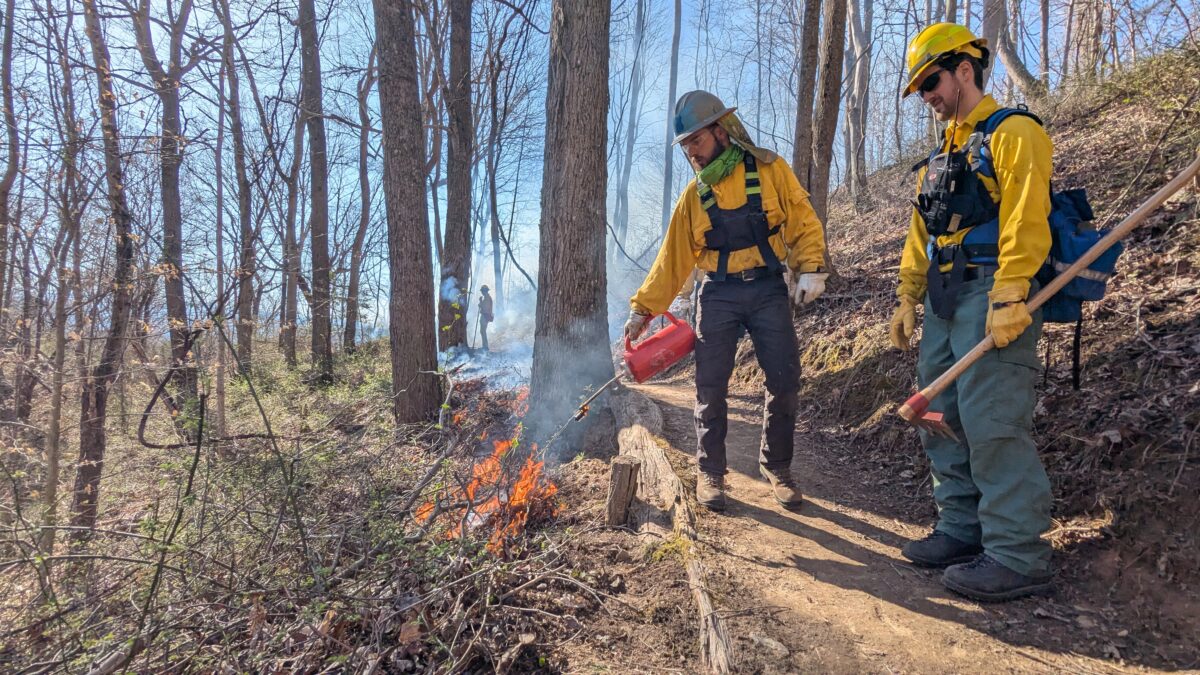
There are many ways to reduce potential fire risk: being FireWise, targeted thinnings and forestry mulching to reduce fuels, and using prescribed fire. We’ve all heard the expression, “fight fire with fire”. That’s exactly what our Wildland Firefighters do, when they go into direct suppression. But what if we could use prescribed fire to serve as a multifaceted tool?
Prescribed fire can be a very cost-effective way to reduce forest fuels as well as to meet forest restoration goals and improve overall forest health. One thing to remember is that one burn will actually promote thick growth in the understory, but a series of prescribed burns can help to create ideal forest conditions for sustainable long-term ecosystem health (especially in mixed oak and oak-pine forests).
Since the Fall 2016 wildfires, public interest has spiked regarding prescribed burning. Following this buildup, landowner demand for prescribed burning services has also increased. Nearly all plans for any type of mixed oak or oak-pine forest will recommend the use of prescribed fire. We can only hope that post-Helene, not only the interest, but more importantly, the willingness and demand for landowners to use prescribed burning will increase.
This website uses cookies
We use cookies to personalize content, provide social media features, and analyze our traffic. We also share information about your use of our site with our analytics partners. You can change your preferences at any time. For more information, please see our Privacy Policy and Cookie Policy.